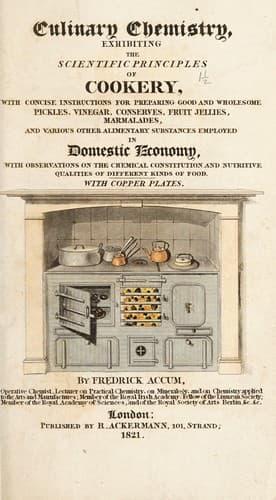
Culinary Chemistry: The Scientific Principles of Cookery, with Concise Instructions for Preparing Good and Wholesome Pickles, Vinegar, Conserves, Fruit Jellies, Marmalades, and Various Other Alimentary Substances Employed in Domestic Economy, with Observations on the Chemical Constitution and Nutritive Qualities of Different Kinds of Food.Accum, Friedrich Christian
Science
Culinary Chemistry: The Scientific Principles of Cookery, with Concise Instructions for Preparing Good and Wholesome Pickles, Vinegar, Conserves, Fruit Jellies, Marmalades, and Various Other Alimentary Substances Employed in Domestic Economy, with Observations on the Chemical Constitution and Nutritive Qualities of Different Kinds of Food.
Accum, Friedrich Christian
Cooking; Food poisoning
The tenderness produced by roasting, we account for, from the expansion
of the watery juices into steam, loosening and dissevering the fibres
one from another, in forcing a passage through the pores to make their
escape by. This violence, also, must rupture all the finer network of
the cellular membranes, besides the smaller nerves and blood vessels
which ramify so numerously through every hair’s-breadth of animal
substance. This dissolution of all the minute parts of the meat, which
must take place before a particle of steam can escape, will most
clearly account both for the tenderness and the altered colour of
roasted meat. The action of heat, also, upon the more solid parts of the
bundles of fibres, will, independent of the expansion of the juices,
cause them to enlarge their volume, and consequently make the smaller
fibres less firmly adhesive.
BROILING.
Another process in which meat is subjected to the immediate action of
fire is broiling, which at first sight seems not to differ from
roasting. The effect on the meat is, however, considerably different.
The process consists in laying chops or slices of meat on clear burning
coals, or a gridiron placed over a clear fire. It is indispensable that
the chops or slices be moderately thin, otherwise the outside will be
scorched to a cinder before they are cooked within; from one fourth to
three fourths of an inch is a proper thickness.[22] It is also necessary
that the fire be moderately brisk, without smoke or flame, lest the meat
should acquire a smoky taste. When a gridiron is used it ought to be
thoroughly heated before the slices or chops are laid on it, to prevent
them from sticking to the bars. In order to broil them equally, they
must be turned from time to time till the cook can easily pierce them
with a fork or sharp skewer, which is the test of them being
sufficiently cooked. It is improper, however, to cut into the chops to
ascertain whether they are broiled enough, because it lets out the
gravy.
[22] It is recommended by cooks to previously beat the raw slices with
a mallet, but this practice is a bad one.
Coke is the best fuel for broiling, for it does not emit any smoke, and
gives a clear and moderate heat; a mixture of coke and charcoal is
exceedingly well calculated for the broiling process.
Those gridirons of the usual appearance and form, that have the bars
fluted or hollowed on the upper side, by which means, the fat that comes
from the meat that is cooked on them, is prevented from falling into the
fire, and causing flame and smoke are the best; for all the grease that
runs down the bars is received into a small trough, which prevents it
from being wasted or lost. The upright gridiron is a still better
invention, as the meat cooked on it, is entirely free from smoke, and
the melted fat is still more easily saved, and kept more clean.
Reviews
Reviews
No reviews yet
Be the first to share your thoughts on this work.
Join the Discussion
Join the discussion
Sign in to leave a comment or review.
Sign InorCreate an account