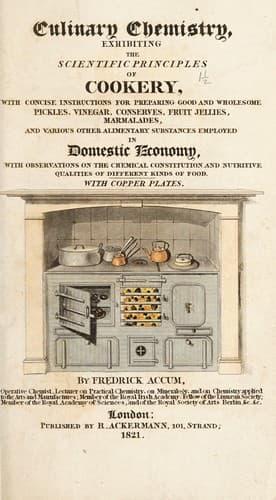
Culinary Chemistry: The Scientific Principles of Cookery, with Concise Instructions for Preparing Good and Wholesome Pickles, Vinegar, Conserves, Fruit Jellies, Marmalades, and Various Other Alimentary Substances Employed in Domestic Economy, with Observations on the Chemical Constitution and Nutritive Qualities of Different Kinds of Food.Accum, Friedrich Christian
Science
Culinary Chemistry: The Scientific Principles of Cookery, with Concise Instructions for Preparing Good and Wholesome Pickles, Vinegar, Conserves, Fruit Jellies, Marmalades, and Various Other Alimentary Substances Employed in Domestic Economy, with Observations on the Chemical Constitution and Nutritive Qualities of Different Kinds of Food.
Accum, Friedrich Christian
Cooking; Food poisoning
_Rationale._--The heat being very quickly and directly applied, not
gradually as in roasting and baking, the surface of the meat is speedily
freed from its watery juices, and the fibres become corrugated, forming
a firm and crisp incrustation of fibre and fat. This crust effectually
prevents the escape of the juices from within; namely, the gelatine, and
the osmazome, which are more rapidly expanded by the heat than in
roasting, and consequently must more violently dissever the small fibres
among which they are lodged, the effect, however, is more mechanical
than chemical, for it does not appear that any new combination is
formed, nor much disorganization produced. Accordingly, it is found that
broiled meat is more sapid, and contains more liquid albumen, gelatine,
and free osmazome, than the same meat would do if boiled or roasted. It
is this greater degree of juicyness, sapidity, and tenderness, that
constitutes the peculiarity and perfection of this mode of cooking,
compared with roasting, baking, or frying in a pan.
Every sort of meat, however, is not fit for broiling. The chemistry of
the process will point out the sorts best adapted for it. The flesh, for
example, of old animals, which is deficient in gelatine and albumen,
would be too much dried by roasting. The larger muscles, also, which
abound in fibrous substance, such as the rump of beef, are well fitted
for broiling. The flesh of game is likewise less juicy and gelatinous,
and forms a very savoury dish when broiled. The process is peculiarly
fit for most sorts of fish, which roasting or baking would render dry
and shrivelled, and in many cases boiling would make it too soft and
pulpy. Fresh caught char, and trout,[23] are in the highest perfection
when dressed in this way.
[23] The best way of eating mackerel, is to broil it in buttered paper
upon the gridiron; and, when properly done, to put fresh butter in the
inside, with chopped parsley, pepper, and salt, which melts, and adds
an exceedingly good flavour to the fish.
On the other hand, the flesh which abounds in watery juices and gelatine
is not well adapted for broiling. The flesh of all young animals is of
this kind; and accordingly lamb, veal, and sucking pig; the flesh of the
fawn and kid do not answer to be broiled but roasted. The same is true
of all the parts of an animal, whatever be its age, which abound more in
gelatine, albumen, and fat, than in red muscular fibre.
Broiled beaf steaks were the established breakfast of the Maids of
Honour of Queen Elizabeth. At an earlier period they gave strength and
vigour to those who
“-----------------------------------drew,
“_And almost joined the horns_ of the tough yew.”
FRYING.
Reviews
Reviews
No reviews yet
Be the first to share your thoughts on this work.
Join the Discussion
Join the discussion
Sign in to leave a comment or review.
Sign InorCreate an account