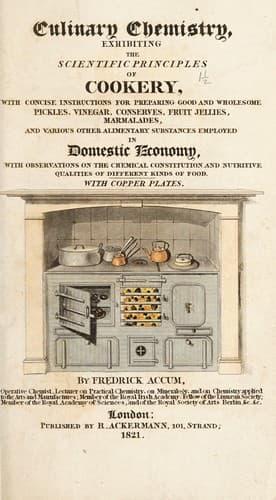
Culinary Chemistry: The Scientific Principles of Cookery, with Concise Instructions for Preparing Good and Wholesome Pickles, Vinegar, Conserves, Fruit Jellies, Marmalades, and Various Other Alimentary Substances Employed in Domestic Economy, with Observations on the Chemical Constitution and Nutritive Qualities of Different Kinds of Food.Accum, Friedrich Christian
Science
Culinary Chemistry: The Scientific Principles of Cookery, with Concise Instructions for Preparing Good and Wholesome Pickles, Vinegar, Conserves, Fruit Jellies, Marmalades, and Various Other Alimentary Substances Employed in Domestic Economy, with Observations on the Chemical Constitution and Nutritive Qualities of Different Kinds of Food.
Accum, Friedrich Christian
Cooking; Food poisoning
Frying is a process somewhat intermediate between roasting and boiling.
Indeed, in one sense, it may be termed boiling, as it is the application
of heat to the substance to be cooked, through the medium of melted fat,
raised to the boiling temperature. The effect on the meat is very
peculiar, and easily distinguished from every other mode of cooking. The
meat is prepared in the same way as in broiling, by cutting it into
chops, or slices, of not more than half an inch or three quarters in
thickness. A sufficient quantity of mutton or beef suet, butter, lard,
or oil, being melted in a pan, and made boiling-hot, the meat is laid in
it. It is not necessary that the meat be _wholly_ immersed in the
boiling fat; if it be immersed in part, it will be quite sufficient.
When flesh is the substance to be fried, the pieces, previously to their
being put into the pan, are sometimes brushed over with eggs and crumbs
of stale bread, flour, or any other farinaceous substance. This
application may also be made when the meat is nearly cooked. The
intention of it is to cover the meat with a thin brown crust, the savour
of which increases the relish of the dish. Fish are, for the most part,
treated in this manner when fried. It answers well with trout, whitings,
flounders, and soles. When this application is made to the meat
previously to its being put into the pan, the peculiar flavour of the
meat is more effectually retained. One of the best preparations for this
purpose is oatmeal, flour, or crumbs of stale bread, made into a liquid
paste with the yolk and white of eggs.
Vegetable, as well as animal substances, are subjected to this process,
though it is always at the expense of their wholesome and nutritive
qualities; and not always to the improvement of their taste and flavour.
As in the case of animal substances, all the juices are, by frying,
extracted from the vegetables; with this difference, however, that their
place is not supplied by the melted fat; for the starch of the
vegetables (potatoes for example) is rendered insoluble in water by the
fat, and exhibits a corneous appearance and texture. Fried potatoes are
the most familiar instance of the process. When cut into thin slices
and fried in oil, butter, or lard, they are rendered semi-transparent.
Cabbage, or the stalks, leaves, and fruits of other vegetable
substances, previously boiled and then fried, shrink, and become more
easy to break, in proportion as the water is driven off from them, as
this, during their previous boiling, dissolves the saccharine and
amylaceous matter which rendered them supple and juicy. These principles
are much better prepared and improved by boiling; they are very much
deteriorated by the boiling fat in the frying pan.
Reviews
Reviews
No reviews yet
Be the first to share your thoughts on this work.
Join the Discussion
Join the discussion
Sign in to leave a comment or review.
Sign InorCreate an account