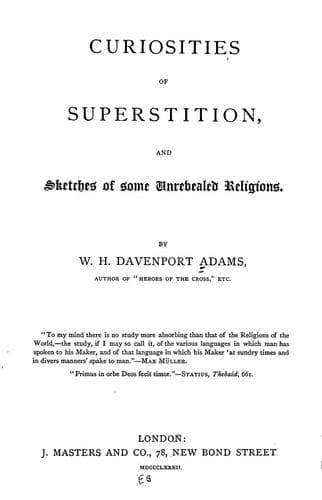
Curiosities of Superstition, and Sketches of Some Unrevealed ReligionsAdams, W. H. Davenport (William Henry Davenport)
Religion
Curiosities of Superstition, and Sketches of Some Unrevealed Religions
Adams, W. H. Davenport (William Henry Davenport)
Folklore; Religions; Superstition
The remarkable man[8] who founded this wide-spread religion is reputed to
have been a prince of the name of Siddhartha, son of Suddhodana, king of
Kapilavastu, a territory supposed to have been situated on the borders of
Oudh and Nipal. He is often called Sakya, after his family, and also
Gautama, from the great “Solar” race of which the family was a branch.[9]
Having at an early age exhibited an ascetic and contemplative tendency,
his father fearing he might be induced to abandon his high station as
Kshatriga, found him a wife in a princess of great personal charms, and
involved him in all the pomp and luxury of a magnificent court. But
Siddhartha drank of the cup only to taste the bitter in the draught; and
each year’s experience of the world convinced him of its inability to
satisfy the aspirations of the soul; so that, like Solomon, he would
exclaim, “Vanity, vanity, all is vanity.” The joys of life could not
render him forgetful of its sorrows. The thought would force itself upon
him that at any moment he might be afflicted with some loathsome or
torturing disease; that his friends might be suddenly snatched away; that
however sunny and bright the present, it could not prevent the inevitable
approach of old age, with its grey hairs, its wrinkled brow, and its
tottering limbs; and that the moral of the whole show was to be sought in
the darkness of the grave. Unable to endure any longer the mental conflict
begotten of his keen sense of the realities as compared with the illusions
of the world, he stole from the guarded palace, and at the age of 29 or
30, went forth as a beggar, or religious mendicant, to study in the
schools of the Brahman priests. He underwent their penances; he mastered
their philosophy; but dissatisfied with their cumbrous code of
superstitious ceremonial, he withdrew into the forest, and adopted a
course of religious asceticism.
This lasted for six or seven years, but brought him no repose. Then he
resolved on returning once more to human companionship. Beset by the
Spirit of Evil he fought long and bravely against temptation, and having
triumphed, prepared to attain the secret of happiness by giving himself up
to abstruse meditation. Week after week he was absorbed in thought,
continually investigating the origin of things, and the mystery of
existence. All the evils under which he, in common with his fellow-men,
groaned, he traced back to birth. Were we not born, we could not suffer.
But whence comes birth or continued existence?... We have no room,
however, to dwell on his processes of thought; enough to say that he came
to the conclusion that the ultimate cause of existence is ignorance, and
that the removal of ignorance means, therefore, the termination of
existence, and of all the pain and sorrow which existence implies and
induces. Realising this absolute unconsciousness of the outer world in his
own self, he claimed and assumed the name of the Buddha, or “Enlightened.”
Public-domain text, read in full here on John Shaqi.
Reviews
Reviews
No reviews yet
Be the first to share your thoughts on this work.
Join the Discussion
Join the discussion
Sign in to leave a comment or review.
Sign InorCreate an account