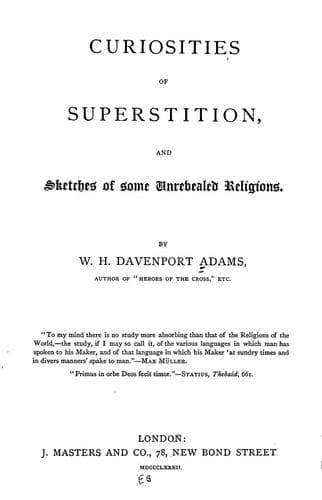
Curiosities of Superstition, and Sketches of Some Unrevealed ReligionsAdams, W. H. Davenport (William Henry Davenport)
Religion
Curiosities of Superstition, and Sketches of Some Unrevealed Religions
Adams, W. H. Davenport (William Henry Davenport)
Folklore; Religions; Superstition
The scene of his victory over life and the world received the name of
Bodhimanda, (the seat of intelligence,) and the tree under which the
religious reformer sat in his hour of moral and intellectual triumph was
called Bodhidruma, (the tree of intelligence,) whence Bo-tree. The
Buddhists believe that it marks the centre of the earth. Hiouen-thsang,
the Chinese pilgrim, professes to have found the Bodhidruma, or some tree
that passed for it, twelve hundred years after Buddha’s death, at a spot
near Gaya Proper, in Bahar, where still may be seen an old dagoba, or
temple, and some considerable ruins.
Having at last attained to a knowledge of the causes of human suffering,
and of the method of removing and counteracting them, the Buddha felt that
the task was imposed upon him of communicating that knowledge to others.
He began “to turn the wheel of the law,”--that is to preach,--at Benares;
and among his earliest disciples was Bimbisara, the ruler of Magadha. His
career as a teacher extended over forty years, during which period he
travelled over almost every part of Northern India, making a large number
of converts, and firmly establishing his religious system. He died at
Kusinagara in Oudh, in 543 B.C., at the age of eighty, and his body being
burned, the relics were distributed among numerous claimants, who raised
monumental tumuli, or topes, for their preservation.
All the expositions and teachings of the Buddha were oral, and the task of
committing them to writing was undertaken by the chief of his disciples
shortly after his death. These canonical books are divided into three
classes, forming the “Tripitaka,” or “three-fold basket.” In the first
class we find the _Soutras_, or Sermons of the Buddha; in the second, the
_Vinaya_, or book of discipline; in the third, the _Abhidharma_, or
philosophy. After a period of a century or so, the Buddhist leaders met
and revised the Tripitaka, and a third revision took place in 250 or 240
B.C., since which date the text has remained without alteration.
The doctrine of Buddha has been defined as a development of four main
principles, (or “Sublime Verities.”) 1st. That every kind of existence is
painful and transitory; 2nd. That all existence is the result of passion;
3rd. That, therefore, the extinction of passion is the one means of escape
from existence and from the misery necessarily attendant upon it; 4th.
That all obstacles to this existence must be swept away.
Public-domain text, read in full here on John Shaqi.
Reviews
Reviews
No reviews yet
Be the first to share your thoughts on this work.
Join the Discussion
Join the discussion
Sign in to leave a comment or review.
Sign InorCreate an account