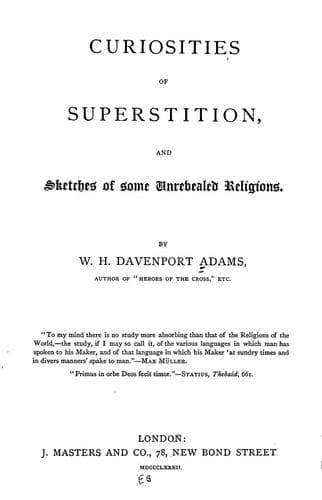
Curiosities of Superstition, and Sketches of Some Unrevealed ReligionsAdams, W. H. Davenport (William Henry Davenport)
Religion
Curiosities of Superstition, and Sketches of Some Unrevealed Religions
Adams, W. H. Davenport (William Henry Davenport)
Folklore; Religions; Superstition
But what is meant by existence? That separation from the general Being of
the world which is involved in individual life, and in the opposition of
the subject which thinks, and the object which is thought about. And what
is meant by its extinction? Not so much annihilation, as the becoming one
with nature, wherein that form of consciousness which separates subject
and object is set aside. This extinction Buddha called Nirvâna, or “the
blowing out of the lamp;” it does not necessarily mean the annihilation of
consciousness altogether, but only of a finite form of it, which may be as
the light of a lamp compared with the light of day.
Buddha’s doctrine has been stigmatised as Atheism and Nihilism, and was
unquestionably liable on its metaphysical side to both charges. It was
Atheistic, not because it denied, for it simply ignored, the existence of
such gods as Indra and Brahma, but because, like the Sankhya philosophy,
it admitted but one subjective Self, and considered creation as an
illusion of that Self, imaging itself for a while in the mirror of Nature.
If there were no reality in nature, there would be no real Creator.
Says Max Müller,[10] stating with his usual clearness a problem which has
perplexed most students of the history of religion: “How a religion which
taught the annihilation of all existence, of all thought, of all
individuality and personality, as the highest object of all endeavours,
could have laid hold of the minds of millions of human beings, and how at
the same time, by enforcing the duties of morality, justice, kindness, and
self-sacrifice, it could have exercised a decided beneficial influence,
not only on the natives of India, but on the lowest barbarians of Central
Asia, is one of the riddles which no philosophy yet has been able to
solve. The morality which it teaches is not a morality of expediency and
rewards. Virtue is not enjoined because it necessarily leads to happiness.
No; virtue is to be practised, but happiness is to be shunned, and the
only reward for virtue is, that it subdues the passions, and thus prepares
the human mind for that knowledge which is to end in complete
annihilation.”
Probably no religious system has ever attained a wide-spread influence
over the minds of men which has held out so few of those inducements most
alluring to human nature. The idea of complete annihilation might
recommend itself to a philosopher, but would hardly have been regarded as
likely to attract the masses. We suppose the explanation is to be found in
the particularity of ritual enjoined by the Buddhist priests, this
particularity of ritual having always had a fascination for the multitude.
Public-domain text, read in full here on John Shaqi.
Reviews
Reviews
No reviews yet
Be the first to share your thoughts on this work.
Join the Discussion
Join the discussion
Sign in to leave a comment or review.
Sign InorCreate an account