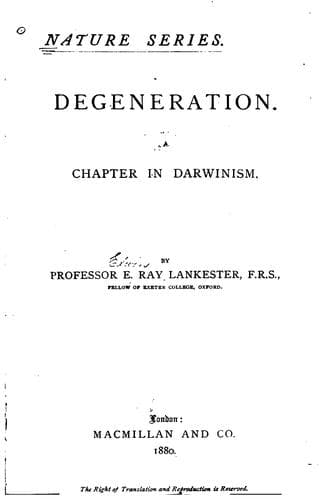
Degeneration: A Chapter in DarwinismLankester, E. Ray (Edwin Ray), Sir
Science
Degeneration: A Chapter in Darwinism
Lankester, E. Ray (Edwin Ray), Sir
Degeneration; Evolution (Biology)
Accordingly, wherever we can note that a group of organisms is
characterized by habits likely to lead to degeneration, such as I have
enumerated, viz., parasitism or immobility, or certain special modes
of nutrition, or again, by minute size of its representatives—there
we are justified in applying the hypothesis of degeneration, even in
the absence of any confirmatory evidence from embryology. When we so
apply this hypothesis we find in not a few cases, in working over the
details of the organization of many different animals by the light
which it affords—that much becomes clear and assignable to cause which,
on the hypothesis either of “balance” or of “elaboration,” is quite
hopelessly obscure. As examples of groups of animals which can thus be
satisfactorily explained I may cite first of all the Sponges: as only
somewhat less degenerate, we have all the Polyps and Coral-animals, also
the Starfishes. Amongst the Mollusca—the group of headless bivalves, the
oysters, mussels and clams, known as the Lamellibranchs, are, when one
once looks at their structure in this light, clearly enough explained
as degenerated from a higher type of head-bearing active creatures like
the Cuttle-fish; whilst the Polyzoa or Moss-polyps stand in precisely
the same kind of relation to the higher Mollusca as do the Ascidians to
the higher Vertebrates: they have greatly degenerated, and become minute
encrusting organisms which, like some of the Ascidians, build up colonies
by plant-like budding growth. The Rotifers, or wheel animalcules, I have
already mentioned as best explained by the supposition that they are the
descendants of far larger and more fully-organized animals provided with
locomotive appendages or limbs: they have dwindled and degenerated to
their present minute size and curiously suggestive structure.
Besides these there are other very numerous cases of animal structure
which can best be explained by the hypothesis of degeneration. A
discussion of these, and a due exposition of the application of the
hypothesis of degeneration to the various groups just cited, would
involve a complete treatise on comparative anatomy and embryology, and
lead far beyond the limitations of this little volume.
Public-domain text, read in full here on John Shaqi.
Reviews
Reviews
No reviews yet
Be the first to share your thoughts on this work.
Join the Discussion
Join the discussion
Sign in to leave a comment or review.
Sign InorCreate an account