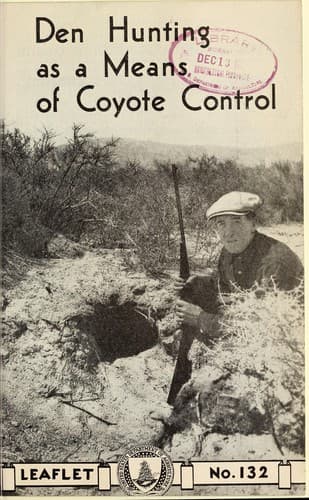
Den Hunting as a Means of Coyote Control — John Shaqi
Den Hunting as a Means of Coyote ControlYoung, Stanley Paul
Science
Den Hunting as a Means of Coyote Control
Young, Stanley Paul
Coyote -- Control
The female continues digging and cleaning out den holes, sometimes a
dozen or more, until the young are born. Then, if one den is disturbed
the family moves to another. Sometimes the animals move only a few
hundred yards, apparently just to have a cleaner home, leaving many fleas
behind. Occasionally a female that has lost her whelps will clean out
several holes before becoming reconciled to her loss. Barren females
sometimes clean out holes, but they are not found traveling with a mate.
Male coyotes also work at many holes in spring but generally to dig
out dead rabbits. The tracks of the male will usually be seen at these
freshly dug holes, which have a different appearance from those cleaned
out for dens, and dried-up rabbit carcasses will generally be found
nearby.
[Illustration: B34748; B30757
Figure 2.--A, Entrance to a coyote den in a dry
creek bank, Morrow County, Oreg.; B, a former Biological Survey
predator-control leader at the mouth of the coyote den dug out near
Cokeville, Wyo. (Remains of three lambs in foreground, including two
skulls out of which the brains had been lapped by coyotes.)]
When entering the den, the coyotes almost always go around, not over, the
mound, if one is present. Dens may have one or several entrances in use,
and several passages may branch from the main one. After the pups are
born, small balls of rolled fur and hair from the mother's belly may be
found in the dry dirt in the mouth of the den.
Parent coyotes have no set time for being at home and may be found near
the den at any hour. Although they do most of their killing early in the
morning, they sometimes visit the den only at night. They are clean about
their dens; so there is little refuse or odor.
Methods of Den Hunting
The proper time for hunting coyote dens is from April 5 to June 15.
If one starts too early, before some of the coyotes have whelped, the
territory will have to be covered again. Where signs indicate a late den,
however, it should be sought in a follow-up visit.
The coyote den is usually made in rougher surroundings than are dens of
small burrowing rodents and is normally within reach of water. Contrary
to general supposition, however, coyotes do not always have their dens
near water. In hilly areas they usually do, but on the large deserts of
eastern Oregon the dens are often found as far as 6 miles from water.
Coyotes do not go to water regularly unless the weather is warm, and pups
do not need water until they are several months old.
Public-domain text, read in full here on John Shaqi.
Reviews
Reviews
No reviews yet
Be the first to share your thoughts on this work.
Join the Discussion
Join the discussion
Sign in to leave a comment or review.
Sign InorCreate an account