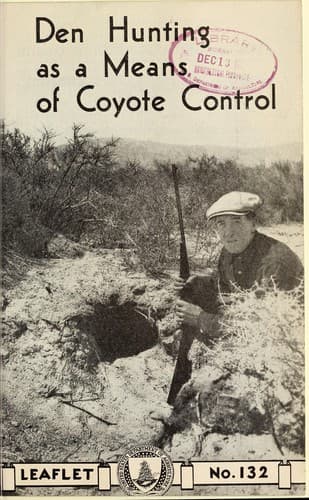
Den Hunting as a Means of Coyote ControlYoung, Stanley Paul
Science
Den Hunting as a Means of Coyote Control
Young, Stanley Paul
Coyote -- Control
Den hunting should be systematic and thorough. Where the soil is sandy
the movements of coyotes can be readily ascertained by means of tracks
and other signs characteristic of the whelping season. The general
location of a den may occasionally be learned by hearing the howling of
the coyotes, but other means must be employed to actually find it. It may
be located by tracking, by watching the movements of old coyotes, or by
riding the range looking for holes, but systematic tracking insures the
best results.
A good time to hunt dens by tracking is just after a rain. Another good
time is the day after a severe windstorm, as storms restrict the activity
of the coyotes.
Water holes and springs in the desert are excellent places from which to
start in locating dens. It is best to circle the water hole, noting the
direction of the tracks and giving special attention to those of pairs
and to their relative freshness, for when fresh tracks of a pair are
noted they are generally close to the den. When sign is found, it should
be back-tracked to a point where there are tracks going both ways; the
tracks begin to form a trail within a quarter of a mile from the dens.
Near the den, unless the ground is too hard, many tracks will be found
going and coming in every direction. Finding the den is then an easy
matter. Sometimes, however, tracks lead to a den from only one direction.
Loose hairs and distinctive tracks are often to be found in the mouth
of a used coyote den. The coyote track is elongated, and not nearly so
rounded as a dog track, and the coyote side-toe track is longer than that
of a dog of the same size. The tracks of young coyotes, barren females,
and those that have lost their pups can be distinguished from those of
denning pairs, as the latter generally travel by a direct route, the
tracks of the female usually being smaller and more pointed than those of
the male.
When the female leaves the den for water she almost always travels on a
direct line, probably not deviating over a hundred yards from it in a
distance of several miles. Coyotes do not always water at the same place
each time, however, nor return to their den direct from the watering
place unless the den is a long distance from water. Sometimes the male
will remain near the den while the female is away, but more often the
two travel together, the female holding a little more to a true course
than the male. The tracks often indicate that they travel side by side
for some distance, the male then wandering away several hundred yards but
later returning to his mate.
Coyotes with dens have regular hunting grounds to which they usually
travel on a nearly straight course, whether near or several miles
distant, but they do not travel back to the den on a direct line again
until after they have made their kills.
Public-domain text, read in full here on John Shaqi.
Reviews
Reviews
No reviews yet
Be the first to share your thoughts on this work.
Join the Discussion
Join the discussion
Sign in to leave a comment or review.
Sign InorCreate an account