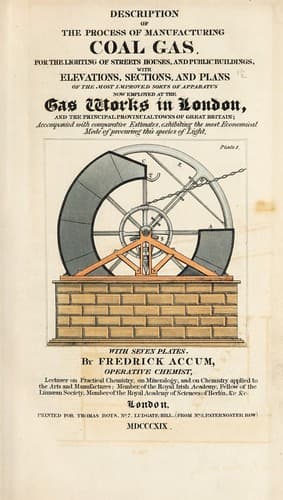
Description of the Process of Manufacturing Coal Gas, for the Lighting of Streets Houses, and Public Buildings: With Elevations, Sections, and Plans of the Most Improved Sorts of Apparatus Now Employed at the Gas Works in London and the Principal Provincial Towns of Great Britain; Accompanied With Comparative Estimates, Exhibiting the Most Economical Mode of Procuring This Species of Light — John Shaqi
Description of the Process of Manufacturing Coal Gas, for the Lighting of Streets Houses, and Public Buildings: With Elevations, Sections, and Plans of the Most Improved Sorts of Apparatus Now Employed at the Gas Works in London and the Principal Provincial Towns of Great Britain; Accompanied With Comparative Estimates, Exhibiting the Most Economical Mode of Procuring This Species of LightAccum, Friedrich Christian
History
Description of the Process of Manufacturing Coal Gas, for the Lighting of Streets Houses, and Public Buildings: With Elevations, Sections, and Plans of the Most Improved Sorts of Apparatus Now Employed at the Gas Works in London and the Principal Provincial Towns of Great Britain; Accompanied With Comparative Estimates, Exhibiting the Most Economical Mode of Procuring This Species of Light
Accum, Friedrich Christian
Gas manufacture and works -- Great Britain; Gas-lighting
Every invention which tends to diminish the labour of men must be a
benefit to the species; and it is wicked to argue against the use of any
thing from its occasional abuse.
If the application of mechanical inventions thus tends to improve the
humanity of the public, if it reduces the necessity of hard labour, and
diminishes the danger of many occupations which we contend it does, they
who contribute to this object deserve our respect and gratitude.
It may be true that we have now no such minds as those of Homer, or
Bacon, or others of their stamp; but we should reflect that the
circumstances which produced such characters are gone by, and great
faculties have found other objects and other materials to work with.
The use of mechanical industry not only improves and augments the
comforts of domestic life, but it also, perhaps, does as much to soften
the feelings of mankind towards one another as the precepts of
philosophy. It tends to engender a detestation of hard labour, and to
make the world consider not what the labourer may be able to do in
tasking him, but what he ought to do without detriment to himself. It
effects this by withdrawing, to a great degree, from observation, the
distressing spectacle of men and animals toiling beyond their strength.
It ought never to be forgotten, that it is to manufactories carried on
by machinery, and abridgment of labour, that this country is indebted
for her riches, independence, and prominent station among the nations of
the world.
Authentic estimates have shewn, that the use of machinery in Great
Britain, is equivalent to an addition to the population of upwards of
_one hundred millions of adult persons_.
This immense accession of power, has enabled this country to withstand
assaults, and to achieve objects of political ambition, that appear
almost miraculous when compared with the geographical extent and
numerical population of the kingdom.
With respect to what has been advanced as to the probable injury that
would result from the general adoption of the gas-lights all over the
country, to the Greenland trade, it may be observed that the traffic
might with more propriety be called a drain than a nursery of the naval
force. The nature of the Greenland service requires that the crew should
consist of able bodied sailors; and being protected men, not subject to
the impress law, they are rendered useless for national defence. The
nursery of British seamen is the coasting trade; and as the gas-light
illumination becomes extended it will increase that trade as much as it
diminishes the Greenland fishery.
Reviews
Reviews
No reviews yet
Be the first to share your thoughts on this work.
Join the Discussion
Join the discussion
Sign in to leave a comment or review.
Sign InorCreate an account