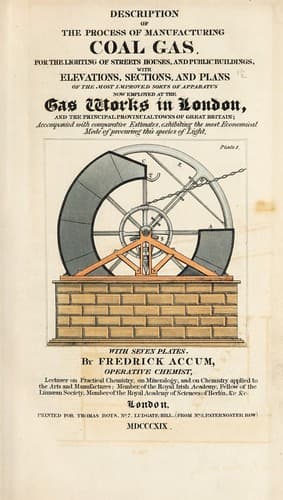
Description of the Process of Manufacturing Coal Gas, for the Lighting of Streets Houses, and Public Buildings: With Elevations, Sections, and Plans of the Most Improved Sorts of Apparatus Now Employed at the Gas Works in London and the Principal Provincial Towns of Great Britain; Accompanied With Comparative Estimates, Exhibiting the Most Economical Mode of Procuring This Species of LightAccum, Friedrich Christian
History
Description of the Process of Manufacturing Coal Gas, for the Lighting of Streets Houses, and Public Buildings: With Elevations, Sections, and Plans of the Most Improved Sorts of Apparatus Now Employed at the Gas Works in London and the Principal Provincial Towns of Great Britain; Accompanied With Comparative Estimates, Exhibiting the Most Economical Mode of Procuring This Species of Light
Accum, Friedrich Christian
Gas manufacture and works -- Great Britain; Gas-lighting
Even on the extreme supposition that it would annihilate the Greenland
fisheries altogether, we should have no reason to regret the event. The
soundest principles of political economy must condemn the practice of
fitting out vessels to navigate the polar seas for oil, if we can
extract a superior material for procuring light at a cheaper rate from
the produce of our own soil. The consequence of lighting our dwellings
and manufactories with gas can in fact prove injurious only to our
continental friends, one of whose staple commodities, tallow, we shall
then have less occasion to purchase, although the new lights can never
supersede entirely the use of candles and moveable lights.
PART II.
_Outline of the new art of procuring light by means of coal gas, and
Theory of the production of Gas Lights._
All substances, whether animal, vegetable, or mineral, consisting of
carbon, hydrogen, and oxigen, when exposed to a red heat, produce
various inflammable elastic fluids, capable of furnishing artificial
light.
The gases thus obtained are called carburetted hydrogen; they produce,
from their combustion, water and carbonic acid. The species of
carburetted hydrogen, procured from pit-coal, has of late been called
_coal gas_.
We perceive the evolution of this elastic fluid, during the combustion
of coal, in a common fire. The coal, when heated to a certain degree,
swells and kindles, and frequently emits remarkably bright streams of
flame. And after a certain period these appearances cease, and the coal
glows with a red light.
The flame produced from coal, wood, turf, oil, wax, tallow, or other
bodies, which are composed of carbon, hydrogen and oxigen, proceeds from
the production of carburetted hydrogen gas, evolved from the combustible
body when in an ignited state.
It must have been noticed at the same time, that in the common mode of
burning coal in a fire-place, or stove, nearly the whole of this
inflammable gaseous matter is lost. We often see a flame suddenly burst
from the densest smoke, and as suddenly disappear; and if a light be
applied to the little jets that issue from the bituminous part of the
coal, they will catch fire and burn with a bright flame. The fact is,
that the greater part of the carburetted hydrogen gas, capable of
affording light and heat, continually escapes up the chimney, during the
decomposition of the coal, whilst only a small part is occasionally
ignited, and exhibits the phenomena of the flame.
Public-domain text, read in full here on John Shaqi.
Reviews
Reviews
No reviews yet
Be the first to share your thoughts on this work.
Join the Discussion
Join the discussion
Sign in to leave a comment or review.
Sign InorCreate an account