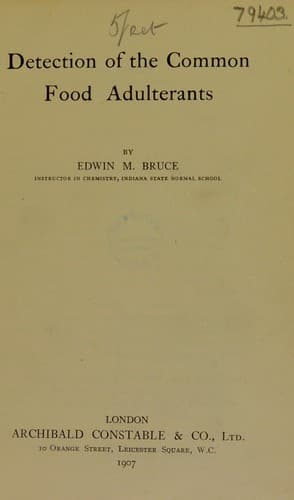
Detection of the Common Food Adulterants — John Shaqi
Detection of the Common Food AdulterantsBruce, Edwin M.
Science
Detection of the Common Food Adulterants
Bruce, Edwin M.
Food adulteration and inspection
_A. W. Stokes’ Method._--Dissolve 1 part by weight of mercury in 2 parts
of nitric acid (sp. gr. 1.42). Add 24 times this volume of water. Mix
equal volumes (about 10 cc.) of this reagent and the milk or cream,
shake well and add 20 cc. of water. Shake again and, after standing 5
minutes, filter. When a great quantity of gelatin is present the
filtrate will be opalescent instead of perfectly clear. To a little of
this filtrate in a test tube add the same volume of a saturated aqueous
solution of picric acid. If much gelatin is present a yellow precipitate
is produced, smaller amounts produce a cloudiness. If the filtrate is
perfectly clear gelatin is absent and picric acid may be added without
producing any noticeable effect.
PRESERVATIVES
FORMALDEHYDE
_Hehner’s Sulfuric Acid Test._--Put 10 cc. of the suspected milk in a
wide test tube and pour carefully down the side of the inclined tube
about 5 cc. commercial sulfuric acid so that it forms a separate layer
at the bottom. A violet coloration at the union of the two liquids
indicates the presence of formaldehyde. If the commercial acid is not
available, the pure acid may be used, but a few drops of ferric chloride
must be added. Sometimes the charring effect of the acid makes it
advisable to use the following test:
_Hydrochloric Acid Test._--2 cc. of 10 per cent ferric chloride is added
to one liter of commercial hydrochloric acid sp. gr. 1.2 (or any
quantity in this proportion). To 10 cc. of this mixture add 10 cc. of
the milk to be tested. Heat the mixture slowly nearly to the boiling
point, in an evaporating dish, but agitating it all the while to prevent
the curd collecting in one mass. If formaldehyde is present, there will
be a violet coloration. It is said that by this test as small a
quantity of formaldehyde as 1 part in 250,000 parts of milk can be
detected. It is not so sensitive in sour milk.
BORIC ACID
_Turmeric Paper Test._--Incinerate some of the milk, and acidulate the
ash with a very few drops of dilute hydrochloric acid and afterwards
dissolve it in a few drops of water. Place a strip of turmeric paper in
this solution for a few minutes, then remove and dry it. If boric acid
either free or combined is present, the turmeric paper will be turned to
a cherry-red color.
_Another way of making this test._--U. S. Dep. of Agr., Div. of Chem.,
Bul. 65, p. 110: Make strongly alkaline with lime water, 25 grams of the
milk, and evaporate to dryness on the water bath. Destroy the organic
matter by igniting the residue. Dilute with 15 cc. of water and acidify
with hydrochloric acid. Then add 1 cc. of the concentrated acid. Dip a
piece of delicate turmeric paper in the solution; and if borax or boric
acid is present, it will have a characteristic red color when dry.
Ammonia changes it to a dark blue green, but the acid will restore the
color.
(Turmeric paper may be prepared by dipping pieces of smooth, thin filter
paper in a solution of powdered turmeric in alcohol.)
Public-domain text, read in full here on John Shaqi.
Reviews
Reviews
No reviews yet
Be the first to share your thoughts on this work.
Join the Discussion
Join the discussion
Sign in to leave a comment or review.
Sign InorCreate an account