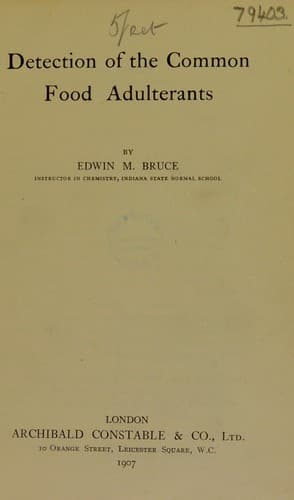
Detection of the Common Food Adulterants — John Shaqi
Detection of the Common Food AdulterantsBruce, Edwin M.
Science
Detection of the Common Food Adulterants
Bruce, Edwin M.
Food adulteration and inspection
Pick apart into fine pieces about 25 or 50 grams of the lean meat and
warm with a little water which has a few drops of hydrochloric acid in
it. Soak a piece of turmeric paper in the extract, and if boric acid is
present the paper will be colored rose-red when it is dry. A weak alkali
turns this colored paper olive.
Another method is to burn a piece of the meat to an ash, after being
treated with lime water. Make a solution of the ash and make slightly
acid with hydrochloric acid. Then test with the turmeric paper with the
same results as in the above method.
SULFUROUS ACID
U. S. Dep. Agr., Bureau Chem., Bul. 13, Part 10: Digest 40 or 50 grams
of the meat in hot water, treat with 10 cc. glacial phosphoric acid to
coagulate the proteids. Strain through a cotton bag and transfer the
filtrate to a short-necked flask and distil receiving the first part of
the distillate in a solution of iodin. Boil, and add barium chloride. If
sulfurous acid is present, it will be oxidized to sulfuric acid and
precipitated as barium sulfate by the barium chlorid. More than a mere
trace of the precipitate proves that some sulfite was used to preserve
the meat.
Another method suggested by Kämmerer is to place the meat on paper,
which has been saturated with potassium iodate moistened with dilute
sulfuric acid (1 : 8); nitric oxid must not be present. If sulfurous
acid is present a deep blue color forms at once. A trace of this color
may form after some time with meat that is not fresh, hence this method
cannot be used in examining canned meat.
SALICYLIC ACID
Heat 50 grams of the meat in 50 cc. of water. Add 10 cc. of a strong
solution of glacial phosphoric acid and strain through a cotton bag.
Extract the filtrate with a little ether (about 50 cc.) in a separatory
funnel. Let the ether evaporate spontaneously. Take up the residue with
3 cc. of water, and add one or two drops of a one-half per cent solution
of ferric chlorid. If salicylic acid is present the mixture will be
purple or violet.
Leach makes the same test by slightly acidifying a portion of the lean
meat, then extracting with ether, and evaporating to dryness and testing
the residue with a drop of ferric chlorid solution. A deep violet
coloration is produced if salicylic acid is present.
BENZOIC ACID
Public-domain text, read in full here on John Shaqi.
Reviews
Reviews
No reviews yet
Be the first to share your thoughts on this work.
Join the Discussion
Join the discussion
Sign in to leave a comment or review.
Sign InorCreate an account