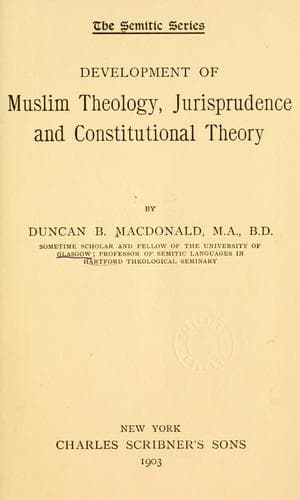
Development of Muslim Theology, Jurisprudence, and Constitutional TheoryMacDonald, Duncan Black
ReligionIslamic
Development of Muslim Theology, Jurisprudence, and Constitutional Theory
MacDonald, Duncan Black
Constitutional law (Islamic law); Islam -- Doctrines -- History; Islam and state -- History; Islamic law -- History
Such was, in its essence, the constitution of Umar, forever famous in
Muslim tradition. It stood for a short time, and could not have stood
for a long time; but the cause of its overthrow was political and not
social-economic. With the next Khalifa and the changes which came with
him, it went, in great part, to the ground. The choice of Umar to the
Khalifate had evidently been dictated by a consideration of his position
as one of the earliest believers and as son-in-law of the Prophet. The
party of Early Believers had thus succeeded twice in electing their
candidate. But with the death of Umar in A.H. 23 (A.D. 644) the Meccan
aristocratic party of the family of Umayya that had so long struggled
against Muhammad and had only accepted Islam when their cause was
hopelessly lost, had at last a chance. Umar left no directions as to his
successor. He seems to have felt no certainty as to the man best fitted
to take up the burden, and when his son sought to urge him to name a
Khalifa, he is reported to have said, “If I appoint a Khalifa, Abu Bakr
appointed a Khalifa; and if I leave the people without guidance, so did
the Apostle of God.” But there is also a story that after a vain attempt
to persuade one of the Companions to permit himself to be nominated,
he appointed an elective council of six to make the choice after his
death under stringent conditions, which went all to wreck through
the pressure of circumstances. The Umayyads succeeded in carrying the
election of Uthman, one of their family, an old man and also a son-in-law
of Muhammad, who by rare luck for them was an Early Believer. After his
election it was soon evident that he was going to rule as an Umayyad
and not as a Muslim. For generations back in Mecca, as has already been
said, there had been, according to tradition, a continual struggle
for pre-eminence between the families of Umayya and of Hashim. In the
victory of Muhammad and the election of the first two Khalifas, the
house of Hashim had conquered, but it had been the constant labor of the
conquerors to remove all tribal and family distinctions and frictions and
to bring the whole body of the Arabs to regard one another as brother
Muslims. Now, with a Khalifa of the house of Umayya, all that was swept
away, and it was evident that Uthman—a pious, weak man, in the hands of
his energetic kinsfolk—was drifting to a point where the state would
not exist for the Muslims but for the Umayyads. His evil spirit was
his cousin Marwan ibn al-Hakam, whom he had appointed as his secretary
and who eventually became fourth Umayyad Khalifa. The father of this
man, al-Hakam ibn al-As, accepted Islam at the last moment when Mecca
was captured, and, thereafter, was banished by Muhammad for treachery.
Not till the reign of Uthman was he permitted to return, and his son,
born after the Hijra, was the most active assertor of Umayyad claims.
Under steady family pressure, Uthman removed the governors of provinces
Public-domain text, read in full here on John Shaqi.
Reviews
Reviews
No reviews yet
Be the first to share your thoughts on this work.
Join the Discussion
Join the discussion
Sign in to leave a comment or review.
Sign InorCreate an account