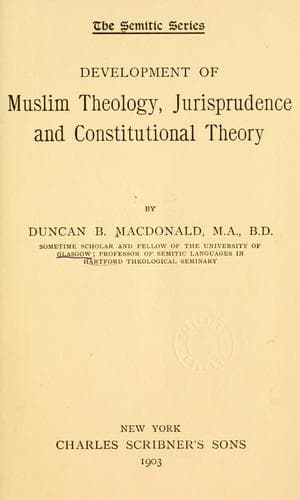
Development of Muslim Theology, Jurisprudence, and Constitutional TheoryMacDonald, Duncan Black
ReligionIslamic
Development of Muslim Theology, Jurisprudence, and Constitutional Theory
MacDonald, Duncan Black
Constitutional law (Islamic law); Islam -- Doctrines -- History; Islam and state -- History; Islamic law -- History
who had suffered with Muhammad and fought in the Path of God (_sabil
Allah_), and put in their places his own relations, late embracers of the
faith. He broke through the Constitution of Umar and gifted away great
tracts of state lands. The feeling spread abroad that in the eyes of the
Khalifa an Umayyad could do no wrong, and the Umayyads themselves were
not backward in affording examples. To the Muhajirs and Ansar they were
godless heathen, and probably the Muhajirs and Ansar were right. Finally,
the indignation could no longer be restrained. Insurrections broke out
in the camp-cities of al-Kufa and al-Basra, and in those of Egypt and
at last in al-Madina itself. There, in A.H. 35 (A.D. 655), Uthman fell
under the daggers of conspirators led by a Muhammad, a son of Abu Bakr,
but a religious fanatic strangely different from his father, and the
train was laid for a long civil war. In the confusion that followed the
deed the chance of the legitimist party had come, and Ali, the cousin and
son-in-law of the Prophet, was chosen.
[Sidenote: SHI‘ITES AND SUNNITES]
Fortunately this is not a history of Islam, but of Muslim political
institutions, and it is, therefore, unnecessary to go into the manifold
and contradictory stories told of the events of this time. These have
evidently been carefully redacted in the interests of later orthodoxy,
and to protect the character of men whose descendants later came to
power. The Alids built up in favor of Ali a highly ingenious but flatly
fictitious narrative, embracing the whole early history and exhibiting
him as the true Khalifa kept from his rights by one after the other
of the first three, and suffering it all with angelic patience. This
varies from the extreme Shi‘ite position, which damns all the three at
a sweep as usurpers, through a more moderate one which contents itself
with cursing Umar and Uthman, to a rejection of Uthman only, and even,
at the other extreme, satisfies itself with anathematizing the later
Umayyads. At this point the Shi‘ites join hands with the body of orthodox
believers, who are all sectaries of Ali to a certain degree. Yet this
tendency has been counteracted to some extent by a strongly catholic
and irenic spirit which manifests itself in Islam. After a controversy
is over and the figures in it have faded into the past, Islam casts a
still deeper veil over the controversy itself and glorifies the actors on
both sides into fathers and doctors of the Church. An attempt is made to
forget that they had fought one another so bitterly, and to hold to the
fact only that they were brother Muslims. The Shi‘ites well so-called,
for _Shi‘a_ means sect, have never accepted this; but it is the usage
of orthodox, commonly called Sunnite, Islam. A concrete expression of
any result reached by the body of the believers then often takes the
form of a tradition assigned to Muhammad. In this case, it is a saying
of his that ten men, specified by name and prominent leaders in these
Public-domain text, read in full here on John Shaqi.
Reviews
Reviews
No reviews yet
Be the first to share your thoughts on this work.
Join the Discussion
Join the discussion
Sign in to leave a comment or review.
Sign InorCreate an account