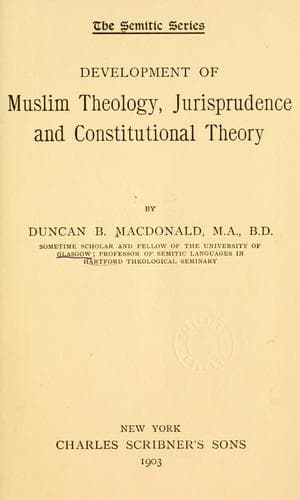
Development of Muslim Theology, Jurisprudence, and Constitutional TheoryMacDonald, Duncan Black
ReligionIslamic
Development of Muslim Theology, Jurisprudence, and Constitutional Theory
MacDonald, Duncan Black
Constitutional law (Islamic law); Islam -- Doctrines -- History; Islam and state -- History; Islamic law -- History
early squabbles, were certain of Paradise. It has further become an
article in Muslim creeds, that the Companions of the Prophet are not to
be mentioned save with praise; and one school of theologians, in their
zeal for the historic Khalifate, even forbade the cursing of Yazid, the
slayer of al-Husayn (p. 28 below), and reckoned as the worst of all the
Umayyads, because he had been a Khalifa in full and regular standing.
This catholic recognition of the unity of Islam we shall meet again and
again.
[Sidenote: ALI; CIVIL WAR]
Abandoning, then, any attempt to trace the details and to adjust the
rights and wrongs of this story, we return to the fixed fact of the
election of Ali and the accession to power of the legitimist party. This
legitimist party, or parties, had been gradually developing, and their
peculiar and mutually discordant views deserve attention. These views all
glorified Ali, the full cousin of Muhammad and husband of his daughter
Fatima, but upon very different grounds. There could not but exist the
feeling that a descendant of the Prophet should be his successor, and the
children of Ali, al-Hasan and al-Husayn were his only grandchildren and
only surviving male descendants. This, of course, reflected a dignity
upon Ali, their father, and gave him a claim to the Khalifate. Again, Ali
himself seems to have made a great and hardly comprehensible impression
upon his contemporaries. The proverb ran with the people, “There is no
sword save _Dhu-l-faqar_, and no youth save Ali.” He was not, perhaps, so
great a general as one or two others of his time, but he stood alone as a
warrior in single combat; he was a poet and an orator, but no statesman.
As one of the earliest of the Early Believers, it might be expected that
the Muhajirs would support him, and so they did; but the matter went much
farther, and he seems to have excited a feeling of personal attachment
and devotion different from that rendered to the preceding Khalifas.
Strange and mystical doctrines were afloat as to his claim. The idea of
election was thrown aside, and his adherents proclaimed his right by the
will and appointment of God to the successorship of the Prophet. As God
had appointed Muhammad as Prophet, so He had appointed Ali as his helper
in life and his successor in death. This was preached in Egypt as early
as the year 32.
Public-domain text, read in full here on John Shaqi.
Reviews
Reviews
No reviews yet
Be the first to share your thoughts on this work.
Join the Discussion
Join the discussion
Sign in to leave a comment or review.
Sign InorCreate an account