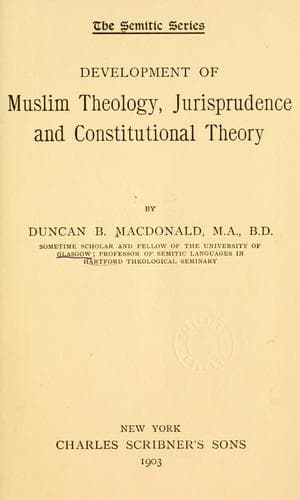
Development of Muslim Theology, Jurisprudence, and Constitutional TheoryMacDonald, Duncan Black
ReligionIslamic
Development of Muslim Theology, Jurisprudence, and Constitutional Theory
MacDonald, Duncan Black
Constitutional law (Islamic law); Islam -- Doctrines -- History; Islam and state -- History; Islamic law -- History
It will easily be seen that with such a following, uniting so many
elements, his election could be brought about. Thus it was; but an evil
suspicion rested upon him. Men thought, and probably rightly, that he
could have saved the aged Uthman if he had willed, and they even went
the length of accusing him of being art and part in the murder itself.
The ground was hollow beneath his feet. Further, there were two other
old Companions of the Prophet, Talha and az-Zubayr, who thought they had
a still better claim to the Khalifate; and they were joined by A’isha,
the favorite wife of Muhammad, now, as a finished _intrigante_, the evil
genius of Islam. Ali had reaped all the advantage of the conspiracy
and murder, and it was easy to raise against him the cry of revenge
for Uthman. Then the civil war began. In the struggle with Talha and
az-Zubayr, Ali was victorious. Both fell at the battle of the Camel
(A.H. 36), so called from the presence of A’isha mounted on a camel
like a chieftainess of the old days. But a new element was to enter.
The governorship of Syria had been held for a long time by Mu‘awiya,
an Umayyad, and there the Umayyad influence was supreme. There, too,
had grown up a spirit of religious indifference, combined with a
preservation of all the forms of the faith. Mu‘awiya was a statesman by
nature, and had moulded his province into an almost independent kingdom.
The Syrian army was devoted to him, and could be depended upon to have
no other interests than his. From the beginning of Ali’s reign, he had
been biding his time; had not given his allegiance, but had waited for
the hour to strike for revenge for Uthman and power for himself. The time
came and Mu‘awiya won. We here pass over lightly a long and contradictory
story. It is enough to note how the irony of history wrought itself out,
and a son of the Abu Sufyan who had done so much to persecute and oppose
Muhammad in his early and dark days and had been the last to acknowledge
his mission, became his successor and the ruler of his people. But with
Ali ends the revered series of the four “Khalifas who followed a right
course” (_al-khulafa ar-rashidun_), reverenced now by all orthodox
Muslims, and there begins the division of Islam into sects, religious and
political—it comes to the same thing.
[Sidenote: KHARIJITES]
Public-domain text, read in full here on John Shaqi.
Reviews
Reviews
No reviews yet
Be the first to share your thoughts on this work.
Join the Discussion
Join the discussion
Sign in to leave a comment or review.
Sign InorCreate an account