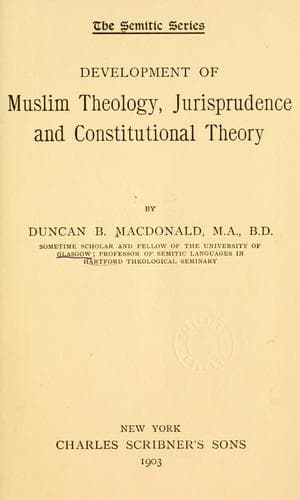
Development of Muslim Theology, Jurisprudence, and Constitutional TheoryMacDonald, Duncan Black
ReligionIslamic
Development of Muslim Theology, Jurisprudence, and Constitutional Theory
MacDonald, Duncan Black
Constitutional law (Islamic law); Islam -- Doctrines -- History; Islam and state -- History; Islamic law -- History
We have seen already that so early as 32 the doctrine had been preached
in Egypt that Ali was the God-appointed successor of the Prophet. Here
we have its legitimate development, which was all the quicker as it had,
or assumed, a theological basis, and did not simply urge the claims
to leadership of the family of the Prophet after the fashion in which
inheritance runs among earthly kings. That was the position at first of
the other and far more important Shi‘ite wing. It regarded the leadership
as being in the blood of Muhammad and therefore limited to the children
of Ali by his wife Fatima, the daughter of Muhammad. Again, the attitude
toward the person of the leader varied, as we have already seen. One
party held that the leadership was by the right of the appointment of
God, but that the leader himself was simply a man as other men. These
would add to “the two words” (_al-kalimatani_) of the creed, “There is
no god but God, and Muhammad is the Apostle of God,” a third clause,
“and Ali is the representative of God.” Others regarded him as an
incarnation of divinity; a continuing divine revelation in human form.
His soul passed, when he died, to his next successor. He was, therefore,
infallible and sinless, and was to be treated with absolute, blind
obedience. Here there is a mingling of the most strangely varied ideas.
In Persia the people had been too long accustomed to looking upon their
rulers as divine for them to be capable of taking up any other position.
A story is told of the governor of a Persian province who wrote to the
Khalifa of his time that he was not able to prevent his people from
giving him the style and treatment of a god; they did not understand any
other kind of ruler; it was as much as his authority was worth to attempt
to make them desist. From this attitude, combined with the idea of the
transmigration of souls, the extreme Shi‘ite doctrine was derived.
[Sidenote: THE HIDDEN IMAM]
Public-domain text, read in full here on John Shaqi.
Reviews
Reviews
No reviews yet
Be the first to share your thoughts on this work.
Join the Discussion
Join the discussion
Sign in to leave a comment or review.
Sign InorCreate an account