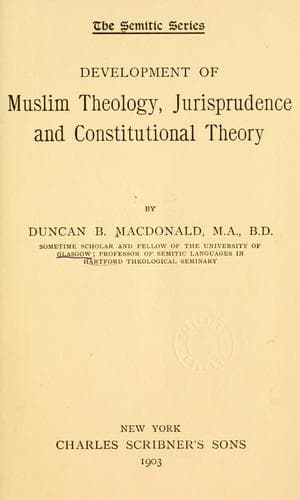
Development of Muslim Theology, Jurisprudence, and Constitutional TheoryMacDonald, Duncan Black
ReligionIslamic
Development of Muslim Theology, Jurisprudence, and Constitutional Theory
MacDonald, Duncan Black
Constitutional law (Islamic law); Islam -- Doctrines -- History; Islam and state -- History; Islamic law -- History
But though the party of Ali might regard the descendants of Ali
as semi-divine, yet their conspiracies and revolts were uniformly
unsuccessful, and it became a very dangerous thing to head one. The
party was willing to get up a rising at any time, but the leader was apt
to hang back. In fact, one of the most curious features of the whole
movement was the uselessness of the family of Ali and the extent to which
they were utilized by others. They have been, in a sense, the cat’s-paws
of history. Gradually they themselves drew back into retirement and
vanished from the stage, and, with their vanishing, a new doctrine
arose. It was that of the hidden Imam. We have already seen the case
of Muhammad ibn al-Hanafiya, whom Muslims reckon as the first of these
concealed ones. Another descendant of Ali, on another line of descent,
vanished in the same way in the latter part of the second century of the
Hijra, and another about A.H. 260. Their respective followers held that
they were being kept in concealment by God and would be brought back at
the appointed time to rule over the world and bring in a kind of Muslim
millennium. This is the oriental version of the story of Arthur in Avalon
and of Frederick Barbarossa in Kyffhaüser.
But that has led us far away and we must go back to the fall of the
Umayyads and the again disappointed hopes of the Alids. By the time
of the last Khalifa of the Umayyad house, Marwan II, A.H. 127-132
(A.D. 744-750), the whole empire was more or less in rebellion, partly
Shi‘ite and partly Kharijite. The Shi‘ites themselves had, as usual, no
man strong enough to act as leader; that part was taken by as-Saffah,
a descendant of al-Abbas, an uncle of Muhammad. The rebellion was
ostensibly to bring again into power the family of the Prophet, but
under that the Abbasids understood the family of Hashim, while the
Alids took it in the more exact sense of themselves. They were made a
cat’s-paw, the Abbasid dynasty was founded, and they were thrown over.
Thus, the Khalifate remained persistently in the hands of those who, up
to the last, had been hostile to the Prophet. This al-Abbas had embraced
the faith only when Mecca was taken by the Muslims. Later historians,
jealous for the good name of the ancestor of the longest line of all
the Successors, have labored to build up a legend that al-Abbas stayed
in Mecca only because he could there be more useful in the cause of his
nephew. This is one of the perversions of early history of which the
Muslim chronicles are full.
[Sidenote: UMAYYADS OF SPAIN]
Public-domain text, read in full here on John Shaqi.
Reviews
Reviews
No reviews yet
Be the first to share your thoughts on this work.
Join the Discussion
Join the discussion
Sign in to leave a comment or review.
Sign InorCreate an account