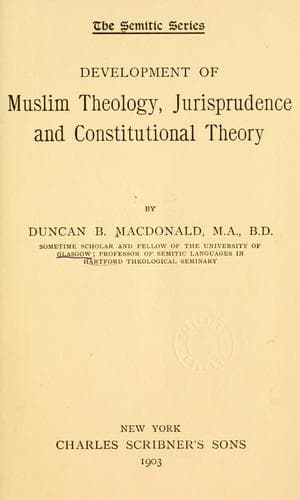
Development of Muslim Theology, Jurisprudence, and Constitutional TheoryMacDonald, Duncan Black
ReligionIslamic
Development of Muslim Theology, Jurisprudence, and Constitutional Theory
MacDonald, Duncan Black
Constitutional law (Islamic law); Islam -- Doctrines -- History; Islam and state -- History; Islamic law -- History
But the story of the Umayyads is not yet out. From the ruin that
overwhelmed them, one escaped and fled to North Africa. There, he vainly
tried to draw together a power. At last, seeing in Spain some better
prospect of success, he crossed thither, and by courage, statesmanship,
and patience, carved out a new Umayyad empire that lasted for 300 years.
One of his descendants in A.H. 317 (A.D. 929) took the title of Khalifa
and claimed the homage due to the Commander of the Faithful. There is a
story that al-Mansur, the second Abbasid, once asked his courtiers, “Who
is the Falcon of Quraysh?” They named one after another of the great men
of the tribe, beginning, naturally, with his majesty himself, but to no
purpose. “No,” he said, “the Falcon of Quraysh is Abd ar-Rahman, the
Umayyad, who found his way over deserts and seas, flung himself alone
into a strange country, and there, without any helper but himself, built
up a realm. There has been none like him of the blood of Quraysh.”
CHAPTER II
Shi‘ite revolts against Abbasids; Idrisids; Zaydites; Imamites;
the Twelvers; constitutional theory of modern Persia; origin
of Fatimids; Maymun the oculist; plan of the conspiracy; the
Seveners; the Qarmatians; Ubayd Allah al-Mahdi and founding of
Fatimid dynasty in North Africa; their spread to Egypt and to
Syria; al-Hakim Bi’amrillah; the Druses; the Assassins; Saladin
and the Ayyubids.
[Sidenote: IDRISIDS]
It is not in place here to deal with all the numberless little Shi‘ite
revolts against the Abbasids which now followed. Those only are of
interest to us which had more or less permanent effect on the Muslim
state and states. Earliest among such comes the revolt which founded
the dynasty of the Idrisids. About the middle of the second century the
Abbasids were hard pressed. The heavens themselves seemed to mingle in
the conflict. The early years of their rule had been marked by great
showers of shooting stars, and the end of the age was reckoned near by
both parties. Messianic hope was alive, and a Mahdi, a Guided of God,
was looked for. This had long been the attitude of the Alids, and the
Abbasids began to feel a necessity to gain for their _de facto_ rule
the sanction of theocratic hopes. In 143 Halley’s comet was visible for
twenty days, and in 147 there were again showers of shooting stars. On
the part of the Abbasids, homage was solemnly rendered to the eldest
son of al-Mansur, the Khalifa of the time, as successor of his father,
under the title al-Mahdi, and several sayings were forged and ascribed
to the Prophet which told who and what manner of man the Mahdi would
be, in terms which clearly pointed to this heir-apparent. The Alids, on
their side, were urged on to fresh revolts. These risings were still
political in character and hardly at all theological; they expressed the
claims to sovereignty of the house of the Prophet. On the suppression
of one of them at al-Madina in 169, Idris ibn Abd Allah, a grandson
Public-domain text, read in full here on John Shaqi.
Reviews
Reviews
No reviews yet
Be the first to share your thoughts on this work.
Join the Discussion
Join the discussion
Sign in to leave a comment or review.
Sign InorCreate an account