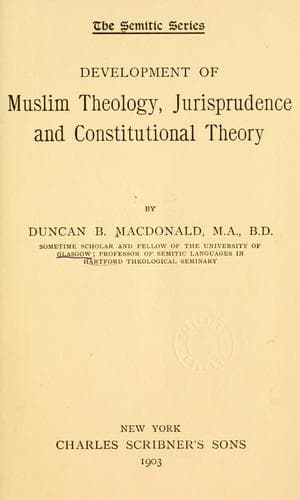
Development of Muslim Theology, Jurisprudence, and Constitutional TheoryMacDonald, Duncan Black
ReligionIslamic
Development of Muslim Theology, Jurisprudence, and Constitutional Theory
MacDonald, Duncan Black
Constitutional law (Islamic law); Islam -- Doctrines -- History; Islam and state -- History; Islamic law -- History
of al-Hasan, escaped to North Africa—that refuge of the politically
disaffected—and there at the far-off Volubilis of the Romans, in the
modern Morocco, founded a state. It lasted till 375, and planted firmly
the authority of the family of Muhammad in the western half of North
Africa. Other Alid states rose in its place, and in 961 the dynasty of
the Sharifs of Morocco was established by a Muhammad, a descendant of
a Muhammad, brother of the same Abd Allah, grandson of al-Hasan. This
family still rules in Morocco and claims the title of Khalifa of the
Prophet and Commander of the Faithful. Strictly, they are Shi‘ites, but
their sectarianism sits lightly upon them; it is political only and they
have no touch of the violent religious antagonism to the Sunnite Muslims
that is to be found in Persian Shi‘ism. As adherents of the legal school
of Malik ibn Anas, their Sunna is the same as that of orthodox Islam.
The _Sahih_ of al-Bukhari (see below, p. 79) is held in especially high
reverence, and one division of the Moorish army always carries a copy of
it as a talisman. They are really a bit of the second century of the
Hijra crystallized and surviving into our time.
Another Shi‘ite line which lasts more or less down to the present day,
is that of the Zaydites of al-Yaman. They were so called from their
adherence to Zayd, a grandson of al-Husayn, and their sect spread in
north Persia and south Arabia. The north Persian branch is of little
historic importance for our purpose. For some sixty-four years, from
250 on, it held Tabaristan, struck coins and exercised all sovereign
rights; then it fell before the Samanids. The other branch has had a
much longer history. It was founded about 280, at Sa‘da in al-Yaman and
there, and later at San‘a, Zaydite Imams have ruled off and on till our
day. The Turkish hold upon south Arabia has always been of the slightest.
Sometimes they have been absolutely expelled from the country, and their
control has never extended beyond the limits of their garrisoned posts.
The position of these Zaydites was much less extreme than that of the
other Shi‘ites. They were strictly Fatimites, that is, they held that any
descendant of Fatima could be Imam. Further, circumstances might justify
the passing over, for a time, of such a legitimate Imam and the election
as leader of someone who had no equally good claim. Thus, they reverenced
Abu Bakr and Umar and regarded their Khalifate as just, even though Ali
was there with a better claim. The election of these two Khalifas had
been to the advantage of the Muslim state. Some of them even accepted
the Khalifate of Uthman and only denounced his evil deeds. Further, they
regarded it as possible that there might be two Imams at the same time,
especially when they were in countries widely apart. This, apparently,
sprang from the sect being divided between north Persia and south Arabia.
Theologically, or philosophically—it is hard to hold the two apart in
Public-domain text, read in full here on John Shaqi.
Reviews
Reviews
No reviews yet
Be the first to share your thoughts on this work.
Join the Discussion
Join the discussion
Sign in to leave a comment or review.
Sign InorCreate an account