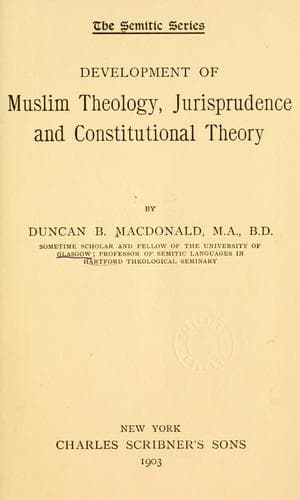
Development of Muslim Theology, Jurisprudence, and Constitutional TheoryMacDonald, Duncan Black
ReligionIslamic
Development of Muslim Theology, Jurisprudence, and Constitutional Theory
MacDonald, Duncan Black
Constitutional law (Islamic law); Islam -- Doctrines -- History; Islam and state -- History; Islamic law -- History
Islam—the Zaydites were accused of rationalism. Their founder, Zayd, the
grandson of al-Husayn, had studied under the great Mu‘tazilite, Wasil ibn
Ata, of whom much more hereafter.
[Sidenote: IMAMITES]
But if the Zaydites were lax both in their theology and in their theory
of the state, that cannot be said of another division of the Shi‘ites,
called the Imamites on account of the stress which they laid on the
doctrine of the person of the Imam. For them the Imam of the time was
explicitly and personally indicated, Ali by Muhammad and each of the
others in turn by his predecessor. But it was hard to reconcile with this
_a priori_ position that an Imam must have been indicated, the fact that
there was no agreement as to the Imam who had been indicated. Down all
possible lines of descent the sacred succession was traced until, of the
seventy-two sects that the Prophet had foretold for his people, seventy,
at least, were occupied by the Imamites alone. Further, the number of
Hidden Imams was constantly running up; with every generation, Alids
found it convenient to withdraw into retirement and have reports given
out of their own deaths. Then two sects would come into existence—one
which stopped at the Alid in question, and said that he was being
kept in concealment by God to be brought back at His pleasure; and
another which passed the Imamship on to the next generation. Out of
this chaos two sects, adhering to two series of Imams, stand clear
through their historical importance. The one is that of the Twelvers
(_Ithna‘ashariya_); theirs is the official creed of modern Persia.
About A.H. 260 a certain Muhammad ibn al-Hasan, twelfth in descent from
Ali, vanished in the way just described. The sect which looked for his
return increased and flourished until, at length, with the conquest of
Persia in A.H. 907 (A.D. 1502) by the Safawids—a family of Alid descent
which joined arms to sainthood—Persia became Shi‘ite, and the series of
the Shahs of Persia was begun. The position of the Shah is therefore
essentially different from that of the Khalifa of the Sunnites. The
Khalifa is the successor of Muhammad, with a dignity and authority which
inheres in himself; he is both king and pontiff; the Shah is a mere
_locum tenens_, and reigns only until God is pleased to restore to men
the true Imam. That Imam is still in existence, though hidden from human
eyes. The Shah, therefore, has strictly no legal authority; he is only
a guardian of the public order. True legal authority lies, rather, with
the learned doctors of religion and law. As a consequence of this, the
Shi‘ites still have _Mujtahids_, divines and legists who have a right to
form opinions of their own, can expound the original sources at first
hand, and can claim the unquestioning assent of their disciples. Such men
have not existed among the Sunnites since the middle of the third century
of the Hijra; from that time on all Sunnites have been compelled to
Public-domain text, read in full here on John Shaqi.
Reviews
Reviews
No reviews yet
Be the first to share your thoughts on this work.
Join the Discussion
Join the discussion
Sign in to leave a comment or review.
Sign InorCreate an account