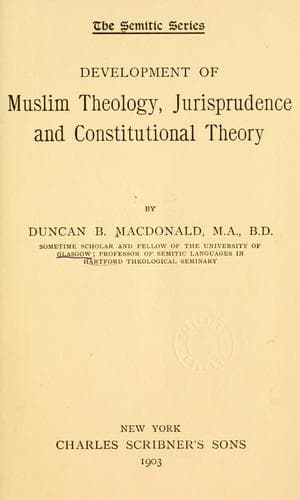
Development of Muslim Theology, Jurisprudence, and Constitutional Theory — John Shaqi
Development of Muslim Theology, Jurisprudence, and Constitutional TheoryMacDonald, Duncan Black
ReligionIslamic
Development of Muslim Theology, Jurisprudence, and Constitutional Theory
MacDonald, Duncan Black
Constitutional law (Islamic law); Islam -- Doctrines -- History; Islam and state -- History; Islamic law -- History
But only half of the work was done. Islam stood as firmly as ever and
the conspiracy had only produced a schism in the faith and had not
destroyed it. Ubayd Allah was in the awkward position, on the one hand,
of ruling a people who were in great bulk fanatical Muslims and did not
understand any jesting with their religion, and, on the other hand, of
being head of a conspiracy to destroy that very religion. The Syrians
and Arabs had apparently taken more degrees than the Egyptians and North
Africans, and Ubayd Allah found himself between the devil and the deep
sea. The Qarmatians in Arabia plundered the pilgrim caravans, stormed
the holy city Mecca, and, most terrible of all, carried off the sacred
black stone. When an enormous ransom was offered for the stone, they
declined—they had orders not to send it back. Everyone understood that
the orders were from Africa. So Ubayd Allah found it advisable to address
them in a public letter, exhorting them to be better Muslims. The writing
and reading of this letter must have been accompanied by mirth, at any
rate no attention was paid to it by the Qarmatians. It was not till
the time of the third Fatimid Khalifa that they were permitted to do
business with that stone. Then they sent it back with the explanatory
or apologetic remark that they had carried it off under orders and now
sent it back under orders. Meanwhile the Fatimid dynasty was running its
course in Egypt but without turning the people of Egypt from Islam. Yet
it produced one strange personality and two sects, stranger even than
the sect to which it itself owed its origin. The personality is that of
al-Hakim Bi’amrillah, who still remains one of the greatest mysteries
that are to be met with in history. In many ways he reminds us curiously
of the madness of the Julian house; and, in truth, such a secret movement
as that of which he was a part, carried on through generations from
father to son, could not but leave a trace on the brain. We must remember
that the Khalifa of the time was not always of necessity the head of the
conspiracy, or even fully initiated into it. In the latter part of the
Fatimid rule we find distinct traces of such a power behind the throne,
consisting, as we may imagine, of descendants and pupils of those who
had been fully initiated from the first and had passed through all the
grades. In the case of al-Hakim, it is possible, even, to trace, to a
certain extent, the development of his initiation. During the first
part of his reign he was fanatically Muslim and Shi‘ite. He persecuted
alternately the Christians and the Jews, and then the orthodox and the
Shi‘ites. In the latter part, there was a change. He had, apparently,
reached a point of philosophical indifference, for the persecutions of
Christians and Jews ceased, and those who had been forced to embrace
Islam were permitted to relapse. This last was without parallel, till
in 1844 Lord Stratford de Redcliffe wrung from the Porte the concession
Public-domain text, read in full here on John Shaqi.
Reviews
Reviews
No reviews yet
Be the first to share your thoughts on this work.
Join the Discussion
Join the discussion
Sign in to leave a comment or review.
Sign InorCreate an account