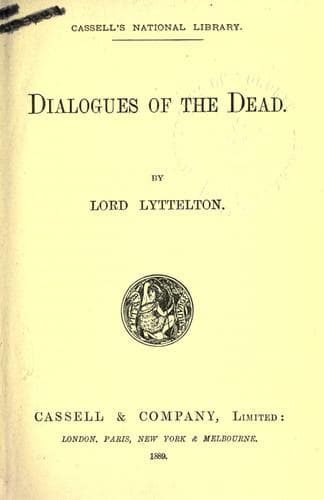
Dialogues of the DeadLyttelton, George Lyttelton, Baron
Philosophy
Dialogues of the Dead
Lyttelton, George Lyttelton, Baron
Dialogues, English -- Early works to 1800; Imaginary conversations
_Boileau_.--The variety, spirit, and force of Mr. Garrick's action have
been much praised to me by many of his countrymen, whose shades I
converse with, and who agree in speaking of him as we do of Baron, our
most natural and most admired actor. I have also heard of another, who
has now quitted the stage, but who had filled, with great dignity, force,
and elevation, some tragic parts, and excelled so much in the comic, that
none ever has deserved a higher applause.
_Pope_.--Mr. Quin was, indeed, a most perfect comedian. In the part of
Falstaff particularly, wherein the utmost force of Shakespeare's humour
appears, he attained to such perfection that he was not an actor; he was
the man described by Shakespeare; he was Falstaff himself! When I saw
him do it the pleasantry of the fat knight appeared to me so bewitching,
all his vices were so mirthful, that I could not much wonder at his
having seduced a young prince even to rob in his company.
_Boileau_.--That character is not well understood by the French; they
suppose it belongs, not to comedy, but to farce, whereas the English see
in it the finest and highest strokes of wit and humour. Perhaps these
different judgments may be accounted for in some measure by the diversity
of manners in different countries. But don't you allow, Mr. Pope, that
our writers, both of tragedy and comedy, are, upon the whole, more
perfect masters of their art than yours? If you deny it, I will appeal
to the Athenians, the only judges qualified to decide the dispute. I
will refer it to Euripides, Sophocles, and Menander.
_Pope_.--I am afraid of those judges, for I see them continually walking
hand-in-hand, and engaged in the most friendly conversation with
Corneille, Racine, and Moliere. Our dramatic writers seem, in general,
not so fond of their company; they sometimes shove rudely by them, and
give themselves airs of superiority. They slight their reprimands, and
laugh at their precepts--in short, they will be tried by their country
alone; and that judicature is partial.
_Boileau_.--I will press this question no further. But let me ask you to
which of our rival tragedians, Racine and Corneille, do you give the
preference?
_Pope_.--The sublimest plays of Corneille are, in my judgment, equalled
by the _Athalia_ of Racine, and the tender passions are certainly touched
by that elegant and most pathetic writer with a much finer hand. I need
not add that he is infinitely more correct than Corneille, and more
harmonious and noble in his versification. Corneille formed himself
entirely upon Lucan, but the master of Racine was Virgil. How much
better a taste had the former than the latter in choosing his model!
_Boileau_.--My friendship with Racine, and my partiality for his
writings, make me hear with great pleasure the preference given to him
above Corneille by so judicious a critic.
Public-domain text, read in full here on John Shaqi.
Reviews
Reviews
No reviews yet
Be the first to share your thoughts on this work.
Join the Discussion
Join the discussion
Sign in to leave a comment or review.
Sign InorCreate an account