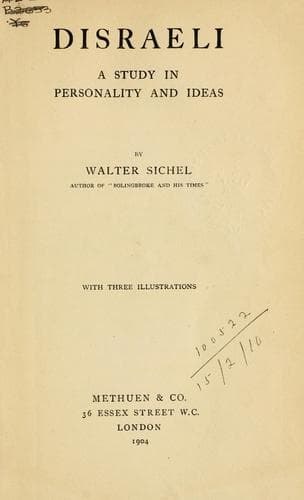
Disraeli: A Study in Personality and IdeasSichel, Walter
History
Disraeli: A Study in Personality and Ideas
Sichel, Walter
Disraeli, Benjamin, 1804-1881
The man, on the other hand, of overwhelming personality, aspires
honourably to power, the very condition of which in his eyes is
to guide and elevate the country which entrusts him with it. The
responsibility of privilege, great position on the tenure of great
duties, ambition not as a right but as the sole means of enforcing
his ideals--these are his characteristics. He never covets place
without power, and never power without influence; whereas some kind of
covetousness is essential to the egotist. “He who has great honours,”
Disraeli has urged, “must have great burdens.” And again: “... My
conception,” he said, in a signal speech during 1846, “of a great
statesman is of one who represents a great idea; an idea which he may
and can impress on the mind and conscience of a nation.... That is a
grand, that is indeed an heroic position. But I care not what may be
the position of a man who never originates an idea--a watcher of the
atmosphere, a man who ... takes his observations, and when he finds
the wind in a certain quarter trims to suit it. Such a person may be
a powerful Minister, but he is no more a great statesman than the man
who gets up behind a carriage is a great whip. Both are disciples of
progress; both perhaps may get a good place. But how far the original
momentum is indebted to their powers, and how far their guiding
prudence regulates the lash or the rein, it is not necessary for me to
notice.”
Disraeli never stooped to trim; he always aspired to steer. When he
started as a brilliant author, electric with ideas derided but since
accepted--as an imaginative originator, “full of deep passions and
deep thoughts”--it would have been easy for him to have followed the
triumphal car of the Whigs who invited him.[6] It would have been easy
for him to have suited himself to Sir Robert Peel’s vicissitudes of
private, and desertion of public opinion, embodied in a great party
which had raised him to power. In obeying again the central ideas which
quickened him from the first, Disraeli broke up the “Young England”
party, which looked up to and cheered him, whose main objects he
inspired, and eventually realised. And in 1867, as we shall see, so
far from “dishing” the Liberals with their own measure of Reform, he
carried, in the teeth of his own supporters, one on lines peculiar to
his own perpetual view of the subject, and at length achieved what he
had urged in the ’thirties, the ’forties, and the ’fifties.
Public-domain text, read in full here on John Shaqi.
Reviews
Reviews
No reviews yet
Be the first to share your thoughts on this work.
Join the Discussion
Join the discussion
Sign in to leave a comment or review.
Sign InorCreate an account