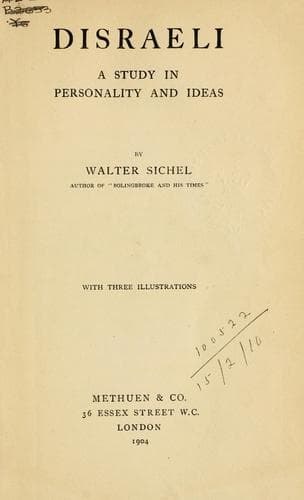
Disraeli: A Study in Personality and Ideas — John Shaqi
Disraeli: A Study in Personality and IdeasSichel, Walter
History
Disraeli: A Study in Personality and Ideas
Sichel, Walter
Disraeli, Benjamin, 1804-1881
In the domain of politics Disraeli, as I shall show at length, divined
in the national institutions the chief engine for the revival of unity
and for social regeneration. When he denounced the Conservatism of the
early ’forties as an “organised hypocrisy,” he did so just because, as
it seemed to his eyes, the hopes once centred on Peel as the restorer
of a truly “national” party were being shattered by his failure, under
ordeal, to govern, to develop the institutions which he was called
on to preserve, by his erection of “registration” into a party idol,
by his policy of polls, by his cold indifference and suspicion of
the youthful regenerators, who confronted the middle classes with
the middle ages. “Whenever,” indignantly urged Disraeli in 1845,
“whenever the young men of England allude to any great principle of
political or parliamentary conduct, are they to be recommended to go
to a railway committee?” And he found in his once chief’s temperament
of discouraging formality and timorous desire for “fixity of tenure,”
for _staying_ power, a reason for the stultification of the House of
Lords: “... It is not Radicalism; it is not the revolutionary spirit
of the nineteenth century which has consigned ‘another place’ to
illustrious insignificance; it is ‘Conservatism’ and a Conservative
dictator.”
Disraeli was one born with aristocratic perceptions, yet with a bent
“popular” rather than “democratic” in the strict sense of those
terms. “Democracy” in the concrete he considered as the unsettlement
of compact nationality through the undue preponderance of a single
class; democracy in the abstract he considered as a lever for ambitious
tribunes. But the welfare of the people was ever his chief concern,
and he knew full well that it is constantly foiled by the side-aims
of those vociferous on its behalf. When he first appeared on the
political horizon, neither of the great historical parties owned
popular sympathies. The Tories dreaded “Radicalism” because they were
blind to the possibilities of its adoption into the order of the
State. Of the Whigs, democratic enthusiasms were at once the tools and
the abhorrence. Disraeli determined to infuse them into those free
yet settled institutions of which the Tories were the natural but
forgetful guardians. His main purpose from the outset was to implant
the new ideas of freedom on the ancient soil of order; to engraft them
productively without uprooting the native undergrowth; to harmonise the
modern democratic idea with those English traditions which had always
harboured its older forms. His work was to accommodate federal to
feudal principles; to render democracy in England national and natural;
to popularise leadership; to make democracy aristocratic in the truest
sense of the term; to undo the closed aristocracy of caste and to
revive the open aristocracy of excellence wherever displayed. My next
two chapters investigate this idea; and it will be found afterwards,
Public-domain text, read in full here on John Shaqi.
Reviews
Reviews
No reviews yet
Be the first to share your thoughts on this work.
Join the Discussion
Join the discussion
Sign in to leave a comment or review.
Sign InorCreate an account