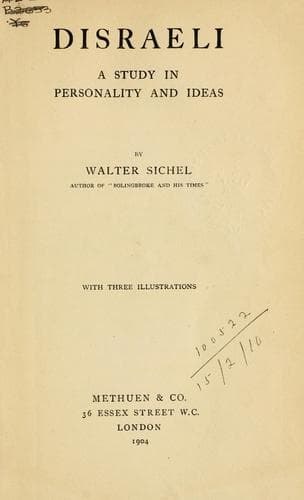
Disraeli: A Study in Personality and Ideas — John Shaqi
Disraeli: A Study in Personality and IdeasSichel, Walter
History
Disraeli: A Study in Personality and Ideas
Sichel, Walter
Disraeli, Benjamin, 1804-1881
when I discuss his notion of empire and his attitude towards our
colonies, that his ideals of Great Britain’s destiny and responsibility
flow straight from this ruling outlook. The same consideration applies
to the many other problems which I shall discuss in the light of
Disraeli’s relations to them. Throughout, in one form or another, and
in many applications, the free play of responsible individuality forms
the keynote. He constantly opposes it alike to the barren uniformity
of republican models, and to the centralising dictatorship whether of
groups or of tyrants. He contrasts the personal with the mechanical.
The State in his eyes should prove the sympathetic expression of the
whole community. These aspects will find ample exposition hereafter. In
this place I wish only to quote their bold and broad emphasis in the
unfamiliar pamphlet of _What is he?_ with one citation from which I
opened this chapter. It will explain those passages in his _Runnymede
Letters_ and _The Spirit of Whiggism_, where he expects and adjures
Peel to head a “national party” and to replace confederacies by a
creed. It will also illustrate that passage in the election address to
High Wycombe during 1832, which preludes his mission as the renewer of
a popular Conservatism. “... Englishmen, behold the unparalleled empire
raised by the heroic energies of your fathers, rouse yourselves in this
hour of doubt and danger, rid yourselves of all that political jargon
and factious slang of Whig and Tory, two names with one meaning, used
only to delude you, and unite in forming a great national party....”
“The first object of a statesman,” he says (and he was then barely
twenty-nine years of age), “is a _strong Government_, without which
there can be no security. Of all countries in the world, England most
requires one, since the prosperity of no society so much depends upon
public confidence as that of the British nation.”
He then declares that the old principle of exclusion (common alike to
the Whig oligarchs and the debased Toryism of Eldon) is dead.
“... The moment the Lords passed the Reform Bill from menace instead
of conviction, the aristocratic principle of government in this
country, in my opinion, expired for ever.” The democratic principle
becomes necessary to maintain a Government at all. “If the Tories,” he
continues, “indeed despair of restoring the aristocratic principle, and
are sincere in their avowal that the State cannot be governed with the
present machinery, it is their duty to coalesce with the Radicals,[47]
and permit both political nicknames to merge into the common, the
intelligible, and the dignified title of a national party.”[48]
He proceeds to prove in a few decisive strokes that the towns are now
the safeguards against any military invasion of rights, and that a
coalition between the then Whigs and the then Tories is impossible;
the only alternative, therefore, is the inclusion of the democratic
principle.
Public-domain text, read in full here on John Shaqi.
Reviews
Reviews
No reviews yet
Be the first to share your thoughts on this work.
Join the Discussion
Join the discussion
Sign in to leave a comment or review.
Sign InorCreate an account