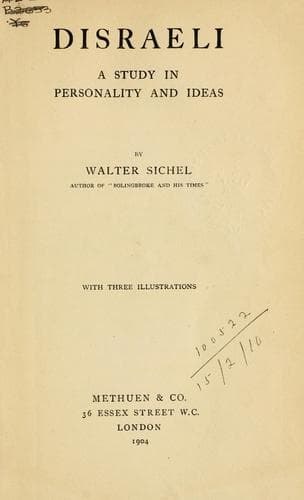
Disraeli: A Study in Personality and IdeasSichel, Walter
History
Disraeli: A Study in Personality and Ideas
Sichel, Walter
Disraeli, Benjamin, 1804-1881
“Without being a system-monger,” he resumes, repeating the refrain
of his previous _Revolutionary Epick_, “I cannot but perceive that
the history of Europe for three hundred years has been a transition
from feudal to federal principles.” If not their origin, these
contending principles have blended with all the struggles that have
occurred.--“The revolt of the Netherlands impelled, if it did not
produce, our revolution against Charles I. That of the Anglo-American
colonies impelled, if it did not produce, the Revolution in France.”
“This,” he says, “is not a party pamphlet, and appeals to the passions
of no order of the State.” “It is wise,” he concludes, “to be sanguine
in public as well as in private life; yet the sagacious statesman
must view the present portents with anxiety, if not with terror. It
would sometimes appear that the loss of our colonial empire must be
the necessary consequence of our prolonged domestic discussions. Hope,
however, lingers to the last. In the sedate but vigorous character of
the British nation we may place great confidence.” The very pressing
unsettlement of those days will afterwards claim a mention; nor should
I now omit Disraeli’s sentence in his _Crisis Examined_, to the effect
that “Lord Grey refusing the Privy Seal and Lord Brougham soliciting
the Chief Barony” were “two epigrammatic episodes in the history of
reform that never can be forgotten.”
Mr. John Morley has well observed that about all Disraeli’s utterance
there was something spacious. The ideas that I am about to examine
are not to be brushed away by the sneers of triflers. Whatever may
be thought of them, and however they may fairly be encountered by
criticism, dissented from or condemned by judgment, they are still
alive. Disraeli bathed the political landscape in a large and luminous
atmosphere. To literature, as I shall hope to show, he lent a fresh and
original charm. Over existence he never ceased to spread the glow of
endeavour, of aspiration, and of purpose. His heart was with the youth
and the labour of England. He made for the strength and union of every
divergent class. He struck and stirred the national imagination.
Disraeli’s sincerity was that of a master in the world’s studio,
imbuing the fainter shapes around him with the vivid colours of the
true pictures in his own brain. It was that, also, of a great man of
action who translates dreams into deeds. It is not often that the
literary mind is allied to a practical bent. He himself has reminded us
that such an union--“as in the case of Caius Julius”--is irresistible.
He was always himself, and never under “the dangerous sympathy with the
creations of others.” He believed that “every man performs his office,
and there is a Power, greater than ourselves, that disposes of all
this.”[49]
Public-domain text, read in full here on John Shaqi.
Reviews
Reviews
No reviews yet
Be the first to share your thoughts on this work.
Join the Discussion
Join the discussion
Sign in to leave a comment or review.
Sign InorCreate an account