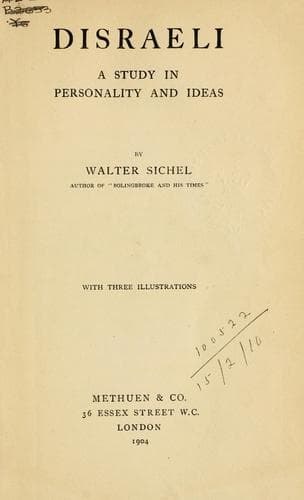
Disraeli: A Study in Personality and IdeasSichel, Walter
History
Disraeli: A Study in Personality and Ideas
Sichel, Walter
Disraeli, Benjamin, 1804-1881
Disraeli’s European prominence is evidenced through the space occupied
by the polyglot literature relating to him in the book catalogue alone
of the British Museum. It extends to eleven of those huge pages. His
importance at home before he became pre-eminent is shown by a shower of
virulent abuse.
Science assures us that the difference between life and death is
that the former holds the powers of growth and reproduction, while
inanimateness is incapable of either. A great man is surely one who
possesses and imparts these qualities of life. Disraeli, without
question, powerfully affected the thought of his generation and the
destinies of the future.
CHAPTER II
DEMOCRACY AND REPRESENTATION
I wish to head this chapter by a most striking passage hitherto
unquoted. It occurs in the fourth of Disraeli’s Letters to the Whigs,
published in the first numbers of _The Press_--an organ founded by him
in 1853 for the exposition of his views.[50] It unites the brilliance
of his youth to the ripeness of his prime. It is a wonderful forecast
of the future, and it embodies his ideas at a time when the “Coalition”
alliance of Peelites, Whigs, and Manchester Radicals--one of “suspended
opinions”--was entering on the career which closed so disastrously. In
1833, the “aristocratic” principle had been crippled. The problem now
was how to bring the new democracy into line with an old monarchy--
“... I see before me a numerous and powerful party, animated by chiefs
whose opinions in favour of all that can advance the cause of pure
democracy have been openly proclaimed. Amongst that party no doubt
there are some more moderate than others, some who march blindfold
towards the goal which those of bolder vision see clear through the
mists of faction. But all unite in the march of the caravan towards
the heart of the desert; and if there be those who then discover that
the fountain which allures them on is but the mirage, it will be too
late to return, and it will be destruction to pause.... If England
is to retain that empire which she owes to no natural resources, but
to the various influences of a most complicated and artificial, but
most admirable and effective social system, _she must gather into one
united phalanx all who hold the doctrine that England, to be safe,
must be great_. To continue free, _she must rest upon the intermediate
institutions that fence round monarchy, as the symbol of executive
force, from that suffrage of unalloyed democracy_ which represents the
invading agencies of legislative change. Our system of policy must be
opposed to all those who by rules of arithmetic would reduce the empire
on which the sun never sets to the isle of the Anglo-Saxon, and leave
our shores without defence against a yet craftier Norman. Our measures
of reform must be so framed as to gain all the purposes of good
government, yet to admit under the name of reform no agency that tends
by its own inevitable laws to the explosion of the machinery whose
Public-domain text, read in full here on John Shaqi.
Reviews
Reviews
No reviews yet
Be the first to share your thoughts on this work.
Join the Discussion
Join the discussion
Sign in to leave a comment or review.
Sign InorCreate an account