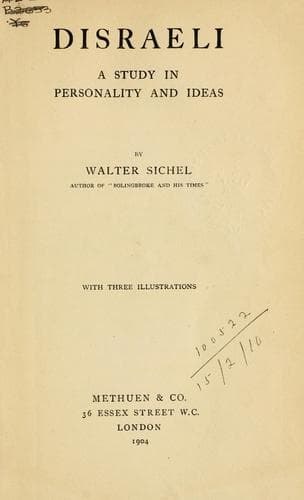
Disraeli: A Study in Personality and IdeasSichel, Walter
History
Disraeli: A Study in Personality and Ideas
Sichel, Walter
Disraeli, Benjamin, 1804-1881
operations you pretend it will economise and quicken.
“By what plausible arguments were the dwellers in the Piræus admitted
to vote in the Athenian assembly?... Hence from that moment arose the
dictator and the demagogue, ... the flatterer and the tyrant of mobs;
hence, the rapid fluctuations, the greedy enterprises, the dominion
of the have-nots, the ruin of the fleet, the loss of the colonies,
the thirty tyrants, the vain restoration of a hollow freedom ...
licence--corruption--servitude--dissolution. Give the popular assembly
of Great Britain up to the _controlling_ influence of the _lowest_
voters in large towns, and you have brought again a Piræus to destroy
your Athens.”
We shall see ere the close how he foiled the schemes for representing
the refuse of opinion.
* * * * *
A great statesman is a man inspired by great ideas; and, since all
history is the visible and particular development of unseen and
universal ideas, it must happen that a great statesman versed in
experience and intuition forecasts and foreknows. For the prophet is
the inverted historian or philosopher: he descries the currents ahead
which the other analyses in retrospect. “To be wise before the event,”
urged Disraeli more than once, “is statesmanship of the highest order.”
Throughout the preceding century two broad aspects of politics, that
is to say of applied national energy, present themselves in England.
They were and remain divergent, but they are and remain mutually
instructive and indispensable.
The one regards our kingdom as an elastic society, the outcome of
native habits expressing national temperament; as a soil of distinctive
character and capacity, to which new plants, if destined to flourish,
must be acclimatised, but on to which, or against which, they must
never be forced.
The other--the “philosophic” school--regards the soil as a mere medium
to be exhaustively manured by chemical processes for the introduction
of growths of every origin, as a sort of “subtropical garden.” It
perceives an idea suitable to other communities or other conjunctures,
and immediately hastens to transplant it. In like manner it perceives
an institution suitable to the race and temper of England, but
unsuitable to some alien race and temper. It is at once for forcible
adoption. It prefers the rigid logic of abstract notions to the
flexibilities of human nature. Its attitude is mechanical instead of
being sympathetic.
The one is in its essence national; the other, if we reflect,
international. The aim of the one is the evolution of individuality
embodied in a nation; that of the other, the ultimate effacement of
nations, and their replacement by cosmopolitanism.
Public-domain text, read in full here on John Shaqi.
Reviews
Reviews
No reviews yet
Be the first to share your thoughts on this work.
Join the Discussion
Join the discussion
Sign in to leave a comment or review.
Sign InorCreate an account