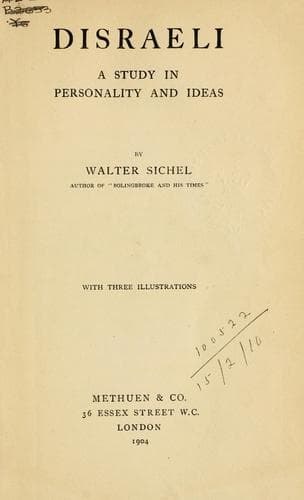
Disraeli: A Study in Personality and Ideas — John Shaqi
Disraeli: A Study in Personality and IdeasSichel, Walter
History
Disraeli: A Study in Personality and Ideas
Sichel, Walter
Disraeli, Benjamin, 1804-1881
These are the logical issues of each system. With the former Burke
identified himself, when he recoiled from following his party into
the anti-national abstractions of the French Revolution. With the
latter Mr. Gladstone identified himself, when he broke loose from the
national idea, and advocated the “right” of every small community
to “govern” itself. The one depends on popular privileges and class
responsibilities evenly distributed--the outcome of national treaty
and compromise, the tact born of struggle, not of upheaval. The other
hinges on inherent “rights,” which are infinite, ubiquitous, abstract,
and indefinite.
Of the former, from first to last, Disraeli, like Canning before him,
was a fearless exponent. “Change,” he said in his famous Edinburgh
speech of 1867, “is inevitable, but the point is whether that change
shall be caused only in deference to the manners, the customs, the
laws, the traditions of the people, or whether it shall be carried
in deference to abstract principles and arbitrary and general
doctrines.... The national system, although it may occasionally
represent the prejudices of a nation, never injures the national
character, while the philosophic system, though it may occasionally
improve ... the condition of the country, precipitates progress, may
occasion revolution and destroy states....” His attitude to the repeal
of the Corn Laws depended, as I shall prove in another chapter, on this
dominant idea. It is in close connection with that idea of personality
which I have already characterised, for nationality is itself the
ideal personality which combines races in communion. It is also in
close connection with that mode of government which seeks salvation
from society and not from the State; and it is bound up with all the
characteristics that distinguish a “nation” from a “people.” Disraeli’s
achievement was to adjust the spirit of England to the spirit of the
age.
Our two parties are, after all, only the strategical forces in the
big campaign of ideas. Without great generals they constantly tend to
forget the issues which nominally enlist them.
At the period when Disraeli first stood on the hustings, “Reform” had
been forced on the Whigs by the “Radicals,” just as “Repeal” was to be
forced some twelve years later on the Conservatives by the Cobdenites.
To be a “Radical” committed one to neither of the legitimate camps.
The Whigs had entered on their kingdom after long years of hopeless
exclusion. They were bent on engrossing office, and none detested the
new-fangled doctrines more than Lord Grey. Disraeli’s purpose from the
very first was to widen and popularise Toryism, but never to maintain
the exclusive system of the Whigs in power by the popular machinery to
which they so often resorted. In a purged and quickened Conservatism
lurked irresistible possibilities, true benefit to the nation and
empire at large, and a golden occasion for himself.
Public-domain text, read in full here on John Shaqi.
Reviews
Reviews
No reviews yet
Be the first to share your thoughts on this work.
Join the Discussion
Join the discussion
Sign in to leave a comment or review.
Sign InorCreate an account