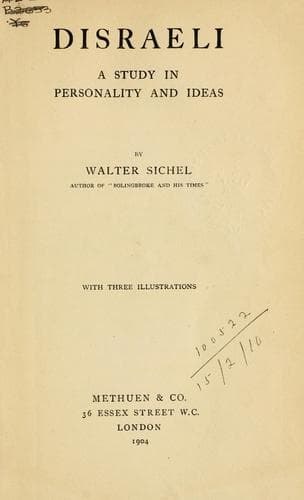
Disraeli: A Study in Personality and IdeasSichel, Walter
History
Disraeli: A Study in Personality and Ideas
Sichel, Walter
Disraeli, Benjamin, 1804-1881
I think that if the oil could have blent with the vinegar, if Peel
could ever have coalesced with Lord John Russell, Disraeli would
have had less chance in politics, and must have been thrown back on
literature.
His consistency stands out prominent in review. It is one of ideas.
It is only by dint of long retrospect over a whole career that we can
decide in the case of any statesman whether he has controlled his
phases, or drifted with them.
From the first Disraeli compassed his reconciliation of new ideas
with ancient institutions on definite principles, at once national
and constructive, as opposed to destructive and international
theories. He desired it through engraftment, not uprootal; through
the defence and development of a constitution which is, in fact, the
British _character_ expressed by the modulations of the national
voice, and not by the shouts of mechanical majorities. He wished in
every case to preserve its efficiency by strengthening its tone and
enlarging its vents; while, in the process, he displayed an insight
into the instincts of classes which the conversance of genius with
ideas can alone empower. Of modern, of cosmopolitan “Liberalism,” he
said, as late as 1872, that its drift and spirit were “to attack the
institutions of the country under the name of reform, and to make war
on the manners and customs of the people of this country under the
pretext of progress.”
What then were the “new ideas” and the “old institutions”?
That form of government which is most national will be best, because
the least liable to sudden and social revolutions; and that form will
be most national which is most genuinely representative; while true
representation is one of power distributed, not centred. It follows
that any Government that does not mirror the nation will break down.
This was the real meaning of the French Revolution.
“... ‘You will observe one curious trait,’ said Sidonia to Coningsby,
‘in the history of this country--the depository of power is always
unpopular. As we see that the Barons, the Church, and the King have in
turn devoured each other, and that the Parliament, the last devourer,
remains, it is impossible to resist the impression that this body also
is doomed to be destroyed.’--‘Where then would you look for hope?’--‘In
what is more powerful than laws and institutions, and without which
the best laws and the most skilful institutions may be a dead letter
and the very means of tyranny, in the national character. It is not
in the increased feebleness of its institutions that I see the peril
of England; it is in the decline of its character as a community....
You may have a corrupt Government and a pure community; you may
have a corrupt community and a pure Administration. Which would you
elect?’--‘Neither,’ said Coningsby, ‘I wish to see a people full of
faith, and a Government full of duty.’”
Public-domain text, read in full here on John Shaqi.
Reviews
Reviews
No reviews yet
Be the first to share your thoughts on this work.
Join the Discussion
Join the discussion
Sign in to leave a comment or review.
Sign InorCreate an account