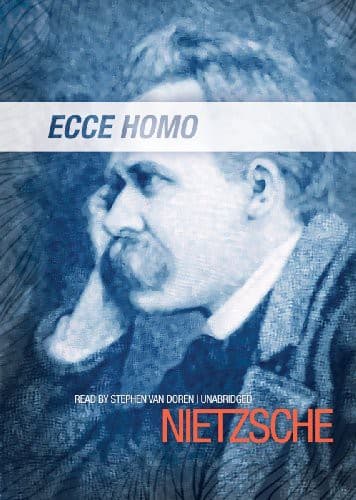
Ecce Homo: Complete Works, Volume SeventeenNietzsche, Friedrich Wilhelm
PhilosophyPhilosophy
Ecce Homo: Complete Works, Volume Seventeen
Nietzsche, Friedrich Wilhelm
Nietzsche, Friedrich Wilhelm, 1844-1900; Philosophers -- Germany -- Biography
Another form of prudence and self-defence consists in trying to
react as seldom as possible, and to keep one's self aloof from those
circumstances and conditions wherein one would be condemned, as it
were, to suspend one's "liberty" and one's initiative, and become a
mere reacting medium. As an example of this I point to the intercourse
with books. The scholar who, in sooth, does little else than handle
books--with the philologist of average attainments their number may
amount to two hundred a day--ultimately forgets entirely and completely
the capacity of thinking for himself. When he has not a book between
his fingers he cannot think. When he thinks, he responds to a stimulus
(a thought he has read),--finally all he does is to react. The scholar
exhausts his whole strength in saying either "yes" or "no" to matter
which has already been thought out, or in criticising it--he is no
longer capable of thought on his own account.... In him the instinct
of self-defence has decayed, otherwise he would defend himself against
books. The scholar is a decadent. With my own eyes I have seen gifted,
richly endowed, and free-spirited natures already "read to ruins" at
thirty, and mere wax vestas that have to be rubbed before they can give
off any sparks--or "thoughts." To set to early in the morning, at the
break of day, in all the fulness and dawn of one's strength, and to
read a book--this I call positively vicious!
9
At this point I can no longer evade a direct answer to the question,
_how one becomes what one is._ And in giving it, I shall have to
touch upon that masterpiece in the art of self-preservation, which is
_selfishness._ ... Granting that one's life-task--the determination and
the fate of one's life-task--greatly exceeds the average measure of
such things, nothing more dangerous could be conceived than to come
face to face with one's self by the side of this life-task. The fact
that one becomes what one is, presupposes that one has not the remotest
suspicion of what one is. From this standpoint even the blunders of
one's life have their own meaning and value, the temporary deviations
and aberrations, the moments of hesitation and of modesty, the
earnestness wasted upon duties which lie outside the actual life-task.
In these matters great wisdom, perhaps even the highest wisdom, comes
into activity: in these circumstances, in which _nosce teipsum_ would
be the sure road to ruin, forgetting one's self, misunderstanding
one's self, belittling one's self, narrowing one's self, and making
one's self mediocre, amount to reason itself. Expressed morally, to
love one's neighbour and to live for others and for other things
_may_ be the means of protection employed to maintain the hardest
kind of egoism. This is the exceptional case in which I, contrary
to my principle and conviction, take the side of the altruistic
instincts; for here they are concerned in subserving selfishness
and self-discipline. The whole surface of consciousness--for
Public-domain text, read in full here on John Shaqi.
Reviews
Reviews
No reviews yet
Be the first to share your thoughts on this work.
Join the Discussion
Join the discussion
Sign in to leave a comment or review.
Sign InorCreate an account