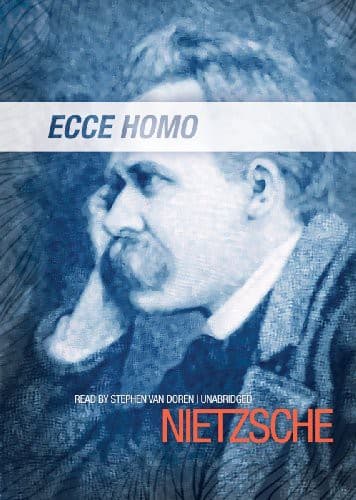
Ecce Homo: Complete Works, Volume SeventeenNietzsche, Friedrich Wilhelm
PhilosophyPhilosophy
Ecce Homo: Complete Works, Volume Seventeen
Nietzsche, Friedrich Wilhelm
Nietzsche, Friedrich Wilhelm, 1844-1900; Philosophers -- Germany -- Biography
My life-task is to prepare for humanity one supreme moment in which it
can come to its senses, a Great Noon in which it will turn its gaze
backwards and forwards, in which it will step from under the yoke
of accident and of priests, and for the first time set the question
of the Why and Wherefore of humanity as a whole--this life-task
naturally follows out of the conviction that mankind does _not_ get
on the right road of its own accord, that it is by no means divinely
ruled, but rather that it is precisely under the cover of its most
holy valuations that the instinct of negation, of corruption, and of
degeneration has held such a seductive sway. The question concerning
the origin of moral valuations is therefore a matter of the highest
importance to me because it determines the future of mankind. The
demand made upon us to believe that everything is really in the best
hands, that a certain book, the Bible, gives us the definite and
comforting assurance that there is a Providence that wisely rules the
fate of man,--when translated back into reality amounts simply to this,
namely, the will to stifle the truth which maintains the reverse of
all this, which is that hitherto man has been in the _worst possible_
hands, and that he has been governed by the physiologically botched,
the men of cunning and burning revengefulness, and the so-called
"saints"--those slanderers of the world and traducers of humanity.
The definite proof of the fact that the priest (including the priest
in disguise, the philosopher) has become master, not only within a
certain limited religious community, but everywhere, and that the
morality of decadence, the will to nonentity, has become morality
_per se,_ is to be found in this: that altruism is now an absolute
value, and egoism is regarded with hostility everywhere. He who
disagrees with me on this point, I regard as infected. But all the
world disagrees with me. To a physiologist a like antagonism between
values admits of no doubt. If the most insignificant organ within the
body neglects, however slightly, to assert with absolute certainty its
self-preservative powers, its recuperative claims, and its egoism, the
whole system degenerates. The physiologist insists upon the removal of
degenerated parts, he denies all fellow-feeling for such parts, and
has not the smallest feeling of pity for them. But the desire of the
priest is precisely the degeneration of the whole of mankind; hence his
preservation of that which is degenerate--this is what his dominion
costs humanity. What meaning have those lying concepts, those handmaids
of morality, "Soul," "Spirit," "Free will," "God," if their aim is not
the physiological ruin of mankind? When earnestness is diverted from
the instincts that aim at self-preservation and an increase of bodily
energy, _i.e._ at an _increase of life_; when anæmia is raised to an
ideal and the contempt of the body is construed as "the salvation of
Public-domain text, read in full here on John Shaqi.
Reviews
Reviews
No reviews yet
Be the first to share your thoughts on this work.
Join the Discussion
Join the discussion
Sign in to leave a comment or review.
Sign InorCreate an account