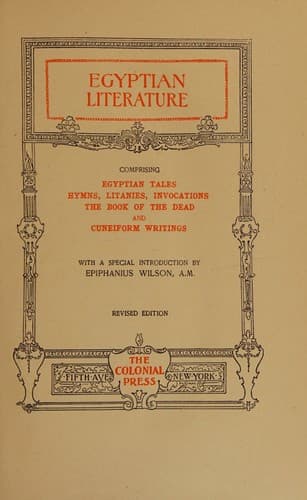
Egyptian Literature: Comprising Egyptian tales, hymns, litanies, invocations, the Book of the Dead, and cuneiform writings
Religion
Egyptian Literature: Comprising Egyptian tales, hymns, litanies, invocations, the Book of the Dead, and cuneiform writings
Egyptian literature -- Translations into English
Osiris is the judge who weighs the souls, and allots them happiness or
misery, according to their deserts. “The Book of the Dead” is interesting
because it teaches how clearly and dogmatically the solemn and precise
Egyptian stated his views and held his convictions concerning the unknown
country. Four parts of man, it was said, survive after death, namely, the
soul, the spirit, the shadow, and the double. The double remains in the
tomb, and only leaves it in search of food. Sometimes it feels its
loneliness and avenges itself upon near relations who have forsaken it.
But the soul hurries to the bar of Osiris, where Thoth weighs the heart in
the scales, and the innocent are admitted into the Field of Beans, a realm
of fertility, where wheat grows seven cubits high. Immortality is spent in
feasting, singing, conversation, and games. But the whole of this
wonderful book is well worth studying. It shows how what Addison calls
“this longing after immortality” led an ancient and deeply religious
people to attempt in their burial rites to rob even the grave of its
terrors, and conjured up out of the shadows of the tomb a clear and
distinct vision of future life, wherein man in his complete individuality
survived to all eternity.
Among the most important results of recent Egyptian exploration must be
reckoned the discovery of the tablets of Tell Amarna. Tell Amarna is a
village in Upper Egypt, and in a pit at the foot of the mountain, at the
base of which it stands, were discovered hundreds of these relics, which
have since been distributed among the museums of London, Berlin, and
Gizeh. The writing on these tablets is cuneiform, and the matter is of
profound historic importance, illustrating, as it does, the relations
between Egypt and western Asia in the fifteenth century B.C. While the
existence of these tablets proves that cuneiform writing was common to
Palestine and Syria as well as the Euphrates Valley, yet curiously enough
the manuscripts of Tell Amarna are different from any of the same kind
that have been found elsewhere, and the language resembles somewhat the
Hebrew of the Old Testament.
While most of these tablets are letters and despatches from friendly
powers in Syria, and from vassal princes in Palestine, others contain
interesting legends. The letters are addressed to the Pharaohs known as
Amenophis III and Amenophis IV, who reigned in the sixteenth and fifteenth
centuries B.C.
Public-domain text, read in full here on John Shaqi.
Reviews
Reviews
No reviews yet
Be the first to share your thoughts on this work.
Join the Discussion
Join the discussion
Sign in to leave a comment or review.
Sign InorCreate an account