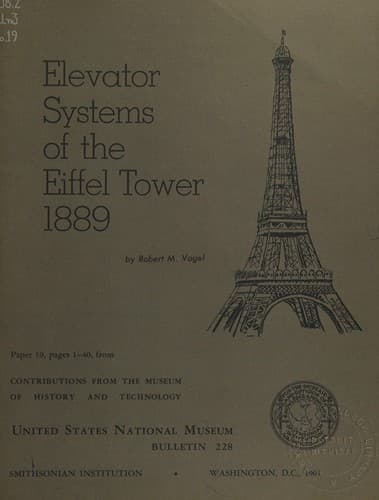
Elevator Systems of the Eiffel Tower, 1889Vogel, Robert M.
History
Elevator Systems of the Eiffel Tower, 1889
Vogel, Robert M.
Elevators -- History; Tour Eiffel (Paris, France)
In the year 1885, the Eiffel firm, which also had an extensive background
of experience in structural engineering, undertook a series of
investigations of tall metallic piers based upon its recent experiences
with several lofty railway viaducts and bridges. The most spectacular of
these was the famous Garabit Viaduct (1880-1884), which carries a railroad
some 400 feet above the valley of the Truyere in southern France. While
the 200-foot height of the viaduct's two greatest piers was not startling
even at that period, the studies proved that piers of far greater height
were entirely feasible in iron construction. This led to the design of a
395-foot pier, which, although never incorporated into a bridge, may be
said to have been the direct basis for the Eiffel Tower.
Preliminary studies for a 300-meter tower were made with the 1889 fair
immediately in mind. With an assurance born of positive knowledge, Eiffel
in June of 1886 approached the Exposition commissioners with the project.
There can be no doubt that only the singular respect with which Eiffel was
regarded not only by his profession but by the entire nation motivated the
Commission to approve a plan which, in the hands of a figure of less
stature, would have been considered grossly impractical.
Between this time and commencement of the Tower's construction at the end
of January 1887, there arose one of the most persistently annoying of the
numerous difficulties, both structural and social, which confronted Eiffel
as the project advanced. In the wake of the initial enthusiasm--on the
part of the fair's Commission inspired by the desire to create a monument
to French technological achievement, and on the part of the majority of
Frenchmen by the stirring of their imagination at the magnitude of the
structure--there grew a rising movement of disfavor. The nucleus was, not
surprisingly, formed mainly of the intelligentsia, but objections were
made by prominent Frenchmen in all walks of life. The most interesting
point to be noted in a retrospection of this often violent opposition was
that, although the Tower's every aspect was attacked, there was remarkably
little criticism of its structural feasibility, either by the engineering
profession or, as seems traditionally to be the case with bold and
unprecedented undertakings, by large numbers of the technically uninformed
laity. True, there was an undercurrent of what might be characterized as
unease by many property owners in the structure's shadow, but the most
obstinate element of resistance was that which deplored the Tower as a
mechanistic intrusion upon the architectural and natural beauties of
Paris. This resistance voiced its fury in a flood of special newspaper
editions, petitions, and manifestos signed by such lights of the fine and
literary arts as De Maupassant, Gounod, Dumas _fils_, and others. The
eloquence of one article, which appeared in several Paris papers in
February 1887, was typical:
Public-domain text, read in full here on John Shaqi.
Reviews
Reviews
No reviews yet
Be the first to share your thoughts on this work.
Join the Discussion
Join the discussion
Sign in to leave a comment or review.
Sign InorCreate an account