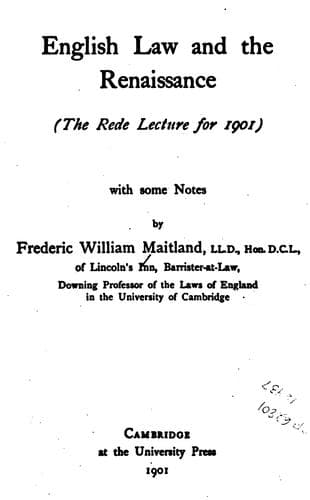
English Law and the Renaissance: The Rede Lecture for 1901Maitland, Frederic William
History
English Law and the Renaissance: The Rede Lecture for 1901
Maitland, Frederic William
Law -- England -- History; Renaissance -- England
The importance of certain law schools will be readily conceded, even to
one who is in some sort officially bound to believe that law schools may
be important. A history of civilization would be miserably imperfect if
it took no account of the first new birth of Roman law in the Bologna
of Irnerius. Indeed there are who think that no later movement,--not
the Renaissance, not the Reformation--draws a stronger line across the
annals of mankind than that which is drawn about the year 1100 when a
human science won a place beside theology. I suppose that the importance
of the school of Bourges would also be conceded. It may be worth our
while to remark that the school of Bologna had a precursor in the school
of Pavia, and that the law which was the main subject of study in the
Pavia of the eleventh century was not Roman law but Lombard law: a body
of barbaric statutes that stood on one level with the Anglo-Saxon laws
of the same age. This I say, not in order that I may remind you what
sort of law it was that Archbishop Lanfranc studied when as a young man
he was a shining light in the school of Pavia, but because this body of
Lombard law, having once become the subject of systematic study, showed
a remarkable vitality in its struggle with Roman jurisprudence. Those
Italian doctors of the middle age who claimed for their science the
fealty of all mankind might have been forced to admit that all was not
well at home. They might call this Lombard law _ius asininum_ and the
law of brute beasts, but it lingered on, and indeed I read that it was
not utterly driven from the kingdom of Naples until Joseph Bonaparte
published the French code. Law schools make tough law[56].
Very rarely do we see elsewhere the academic teaching of any law that
is not Roman: imperially or papally Roman. As a matter of course the
universities had the two legal faculties, unless, as at Paris, the Pope
excluded the legists from an ecclesiastical preserve. The voice of John
Wyclif pleading that English law was the law that should be taught
in English universities was a voice that for centuries cried in the
wilderness. It was 1679 before French law obtained admission into the
French universities[57]. It was 1709 before Georg Beyer, a pandectist
at Wittenberg, set a precedent for lectures on German law in a German
university[58]. It was 1758 before Blackstone began his ever famous
course at Oxford. The chair that I cannot fill was not established
until the transatlantic Cambridge was setting an example to her elderly
mother[59]. But then, throughout the later middle age English law had
been academically taught.
Public-domain text, read in full here on John Shaqi.
Reviews
Reviews
No reviews yet
Be the first to share your thoughts on this work.
Join the Discussion
Join the discussion
Sign in to leave a comment or review.
Sign InorCreate an account