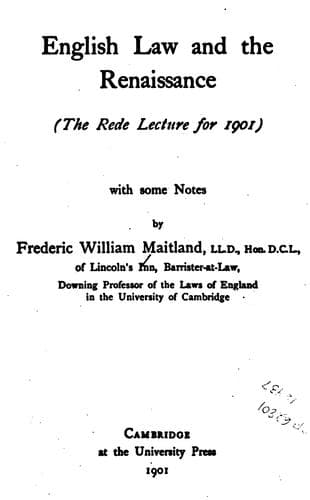
English Law and the Renaissance: The Rede Lecture for 1901 — John Shaqi
English Law and the Renaissance: The Rede Lecture for 1901Maitland, Frederic William
History
English Law and the Renaissance: The Rede Lecture for 1901
Maitland, Frederic William
Law -- England -- History; Renaissance -- England
And then we see that in 1535, the year in which More was done to death,
the Year Books come to an end: in other words, the great stream of law
reports that has been flowing for near two centuries and a half, ever
since the days of Edward I, becomes discontinuous and then runs dry.
The exact significance of this ominous event has never yet been duly
explored; but ominous it surely is[49]. Some words that once fell from
Edmund Burke occur to us: ‘To put an end to reports is to put an end to
the law of England[50].’ Then in 1547 just after King Henry’s death a
wail went up from ‘divers students of the common laws.’ The common laws,
they said, were being set aside in favour of ‘the law civil’ insomuch
that the old courts had hardly any business[51]. Ten years later, at the
end of Mary’s reign, we read that the judges had nothing to do but ‘to
look about them,’ and that for the few practitioners in Westminster Hall
there was ‘elbow room enough[52].’ In criminal causes that were of any
political importance an examination by two or three doctors of the civil
law threatened to become a normal part of our procedure[53]. In short, I
am persuaded that in the middle years of the sixteenth century and of the
Tudor age the life of our ancient law was by no means lusty.
And now we may ask what opposing force, what conservative principle
was there in England? National character, the genius of a people, is
a wonder-working spirit which stands at the beck and call of every
historian. But before we invoke it on the present occasion we might
prudently ask our books whether in the sixteenth century the bulk of
our German cousins inherited an innate bias towards what they would
have called a Welsh jurisprudence. There seems to be plentiful evidence
that the learned _doctores iuris_ who counselled the German princes and
obtained seats in the courts were cordially detested by the multitude.
In modern times they often have to bear much blame for that terrible
revolt which we know as the Peasants’ War[54]. No doubt there were many
differences between England and Germany, between England and France,
between England and Scotland[55]. Let us notice one difference which,
if I am not mistaken, marked off England from the rest of the world.
Medieval England had schools of national law.
Public-domain text, read in full here on John Shaqi.
Reviews
Reviews
No reviews yet
Be the first to share your thoughts on this work.
Join the Discussion
Join the discussion
Sign in to leave a comment or review.
Sign InorCreate an account