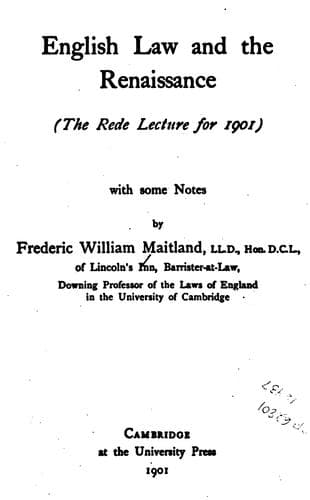
English Law and the Renaissance: The Rede Lecture for 1901Maitland, Frederic William
History
English Law and the Renaissance: The Rede Lecture for 1901
Maitland, Frederic William
Law -- England -- History; Renaissance -- England
No English institutions are more distinctively English than the Inns of
Court; of none is the origin more obscure. We are only now coming into
possession of the documents whence their history must be gathered, and
apparently we shall never know much of their first days[60]. Unchartered,
unprivileged, unendowed, without remembered founders, these groups
of lawyers formed themselves and in course of time evolved a scheme
of legal education: an academic scheme of the medieval sort, oral
and disputatious. For good and ill that was a big achievement: a big
achievement in the history of some undiscovered continents. We may well
doubt whether aught else could have saved English law in the age of the
Renaissance. What is distinctive of medieval England is not parliament,
for we may everywhere see assemblies of Estates, nor trial by jury, for
this was but slowly suppressed in France. But the Inns of Court and
the Year Books that were read therein, we shall hardly find their like
elsewhere. At all events let us notice that where Littleton and Fortescue
lectured, there Robert Rede lectures, Thomas More lectures, Edward Coke
lectures, Francis Bacon lectures, and highly technical were the lectures
that Francis Bacon gave. Now it would, so I think, be difficult to
conceive any scheme better suited to harden and toughen a traditional
body of law than one which, while books were still uncommon, compelled
every lawyer to take part in legal education and every distinguished
lawyer to read public lectures. That was what I meant when I made bold to
say that Robert Rede was not only an English judge but ‘what is more’ a
reader in English law.
_Deus bone!_ exclaimed Professor Smith in his inaugural lecture, and what
excited the learned doctor to this outcry was the skill in disputation
shown by the students of English law in their schools at London. He was
endeavouring to persuade his hearers that in many ways the study of law
would improve their minds. If, he urged, these young men, cut off as
they are from all the humanities, can reason thus over their ‘barbaric
and semi-gallic laws,’ what might not you, you cultivated scholars do if
you studied the Digest and Alciatus and Zasius? And then the professor
expressed a hope that he might be able to spend his vacation in the Inns
of Court[61]. His heart was in the right place: in a school of living
law. Even for the purposes of purely scientific observation the live dog
may be better than the dead lion.
Public-domain text, read in full here on John Shaqi.
Reviews
Reviews
No reviews yet
Be the first to share your thoughts on this work.
Join the Discussion
Join the discussion
Sign in to leave a comment or review.
Sign InorCreate an account