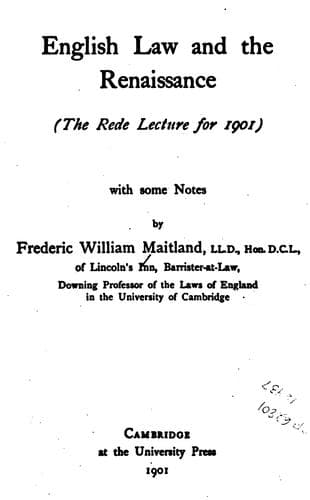
English Law and the Renaissance: The Rede Lecture for 1901Maitland, Frederic William
History
English Law and the Renaissance: The Rede Lecture for 1901
Maitland, Frederic William
Law -- England -- History; Renaissance -- England
When the middle of the century is past the signs that English law has a
new lease of life become many. The medieval books poured from the press,
new books were written, the decisions of the courts were more diligently
reported, the lawyers were boasting of the independence and extreme
antiquity of their system[62]. We were having a little Renaissance of
our own: or a gothic revival if you please. The Court of Requests in
which Prof. Smith and Prof. Haddon had done justice was being tried
for its life. Its official defender was, we observe, Italian by blood
and Parisian by degree: Dr Adelmare, known to Englishmen as Sir Julius
Caesar[63]. That wonderful Edward Coke was loose. The medieval tradition
was more than safe in his hands. You may think it pleasant to turn from
this masterful, masterless man to his great rival. It is not very safe
to say what Thomas More did not know, less safe to say what was unknown
to Francis Bacon, but I cannot discover that either of these scholars,
these philosophers, these statesmen, these law reformers, these schemers
of ideal republics, these chancellors of the realm, these law lecturers,
had more than a bowing acquaintance with Roman law.
If Reginald Pole’s dream had come true, if there had been a
Reception--well, I have not the power to guess and you have not the
time to hear what would have happened; but I think that we should have
had to rewrite a great deal of history. For example, in the seventeenth
century there might have been a struggle between king and parliament,
but it would hardly have been that struggle for the medieval, the
Lancastrian, constitution in which Coke and Selden and Prynne and other
ardent searchers of mouldering records won their right to be known to
school-boys. In 1610 when the conflict was growing warm a book was burnt
by the common hangman: it was written by an able man in whom Cambridge
should take some pride, Dr Cowell, our Regius Professor, and seemed to
confirm the suspicion that Roman law and absolute monarchy went hand in
hand[64].
The profit and loss account would be a long affair. I must make no
attempt to state it. If there was the danger of barbarism and stupidity
on the one side, there was the danger of pedantry on the other: the
pedantry that endeavours to appropriate the law of another race and
galvanizes a dead Corpus Juris into a semblance of life. Since the first
of January 1900 the attempt to administer law out of Justinian’s books
has been abandoned in Germany. The so-called ‘Roman-Dutch’ law of certain
outlying parts of the British Empire now stands alone[65], and few, I
imagine, would foretell for it a brilliant future, unless it passes into
the hand of the codifier and frankly ceases to be nominally Roman. Let us
observe, however, that much had been at stake in the little England of
the sixteenth century.
Public-domain text, read in full here on John Shaqi.
Reviews
Reviews
No reviews yet
Be the first to share your thoughts on this work.
Join the Discussion
Join the discussion
Sign in to leave a comment or review.
Sign InorCreate an account