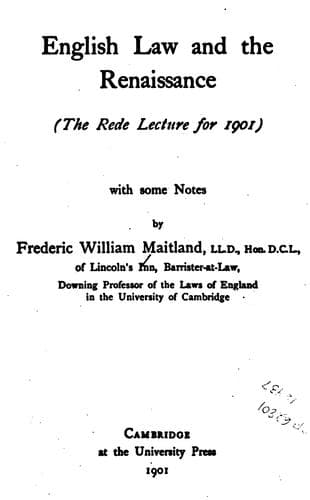
English Law and the Renaissance: The Rede Lecture for 1901Maitland, Frederic William
History
English Law and the Renaissance: The Rede Lecture for 1901
Maitland, Frederic William
Law -- England -- History; Renaissance -- England
[27] Elizabeth’s invitation to Hotman is mentioned in the _Elogium_ of
him prefixed to his _Opera_ (1599), p. viii, and in Dareste’s essay
(p. 5). His son John spent some time at Oxford. In 1583 John tells his
father that at Oxford he has plenty of time for study ‘quamvis hic miris
modis frigeat iuris civilis studium et mea hac in re opera nemini grata
possit esse in Anglia’ (_Hotomanorum Epistolae_, Amstd., 1620, p. 325).
In 1584 John was consulted along with Alberigo Gentili by the English
government in the Mendoza case (Holland, _Albericus Gentilis_, pp. 14,
15). There is nothing improbable in the story that Francis was offered
a post at Oxford. He must have been well known to Cecil. In 1562 he was
active in bringing Condé into touch with Elizabeth and so in promoting
the expedition to Havre. Condé’s envoy brought to Cecil a letter of
introduction from Hotman (_Foreign Calendar_, 1561-2, p. 601). Baudouin
also at this time was making himself useful to the English government.
(See e.g. _Foreign Calendar_, 1558-9, p. 173; 1561-2, pp. 60, 367, 454,
481, 510.) It has been said that Queen Elizabeth spoke of Charles Du
Moulin as her kinsman (Brodeau, _Vie de C. Du Molin_, p. 4). Whether in
the pedigree of the Boleyns there is any ground for this story I do not
know. See _La France protestante_, ed. 2, vol. V., col. 783. Sir Thomas
Craig, who is an important figure in the history of Scotch law, sat at
the feet of Baudouin, and Edward Henryson, who in 1566 became a lord of
session, had been a professor at Bourges (_Dict. Nat. Biog._).
[Sidenote: _Francis Hotman and Roman law._]
[28] The _Epistre adressée au tygre de la France_, a violent invective
against the Cardinal of Lorraine, still finds admirers among students of
French prose. Apparently Hotman would have been the last man to preach
a Reception of Roman law in England. Being keenly alive to the faults
of Justinian’s books, he resisted the further romanization of French
law, demanded a national code, admired the English limited monarchy,
and by his _Franco-Gallia_ made himself in some sort the ancestor of
the ‘Germanists.’ Some of these ‘elegant’ French jurists were so much
imbued with the historical spirit that in their hands the study of Roman
law became the study of an ancient history. The following words cited
and translated by Dareste from Baudouin (_François Hotman_, p. 19) have
a wonderfully modern sound: ‘Ceux qui ont étudié le droit auraient pu
trouver dans l’histoire la solution de bien des difficultés, et ceux
qui ont écrit l’histoire auraient mieux fait d’étudier le développement
des lois et des institutions, que de s’attacher à passer en revue les
armées, à décrire les camps, à raconter les batailles, à compter les
morts.’ ‘_Sine historia caecam esse iurisprudentiam_, disait Baudouin.’
(Brissaud, _Histoire du droit français_, p. 349).
[Sidenote: _Coke and Hotman. Polydore Virgil._]
Public-domain text, read in full here on John Shaqi.
Reviews
Reviews
No reviews yet
Be the first to share your thoughts on this work.
Join the Discussion
Join the discussion
Sign in to leave a comment or review.
Sign InorCreate an account