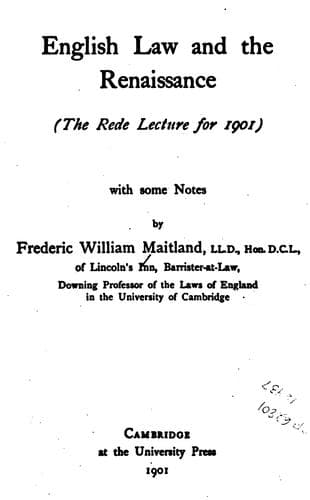
English Law and the Renaissance: The Rede Lecture for 1901 — John Shaqi
English Law and the Renaissance: The Rede Lecture for 1901Maitland, Frederic William
History
English Law and the Renaissance: The Rede Lecture for 1901
Maitland, Frederic William
Law -- England -- History; Renaissance -- England
[29] Coke, Introductory Letter to Part 10 of the _Reports_, and Preface
to Coke upon Littleton (_First Institute_). The words of Hotman which
moved Coke to wrath will be found in _De verbis feudalibus commentarius_
(F. Hotmani Opera, ed. 1599, vol. II., p. 913) s.v. _feodum_. Hotman
remarks that the English use the word _fee_ (longissime tamen a
Langobardici iuris ratione et instituto) to signify ‘praedia omnia quae
perpetuo iure tenentur.’ He then adds that Stephanus Pasquerius (the
famous Étienne Pasquier) had given him Littleton’s book: ‘ita incondite,
absurde et inconcinne scriptum, ut facile appareat verissimum esse quod
Polydorus Virgilius in Anglica Historia de iure Anglicano testatus est,
stultitiam in eo libro cum malitia et calumniandi studio certare.’ To
a foreign ‘feudist’ Littleton’s book would seem absurd enough, because
in England the _feudum_ had become the general form in which all
land-ownership appeared. Brunner (_Deutsche Rechtsgeschichte_, vol. II.,
p. 11) puts this well: ‘Wo jedes Grundeigentum sich in Lehn verwandelt,
wird das Lehn, wie die Entwicklung des englischen Rechtes zeigt,
schliesslich zum Begriff des Grundeigentums.’
I have not found in Polydore Virgil’s History anything about Littleton.
There is a passage however in lib. IX. (ed. Basil. 1556, p. 154) in which
he denounces the unjust laws imposed by William the Conqueror and (so he
says) still observed in his own day: ‘Non possum hoc loco non memorare
rem tametsi omnibus notam, admiratione tamen longe dignissimam, atque
dictu incredibilem: eiusmodi namque leges quae ab omnibus intelligi
deberent, erant, ut etiam nunc sunt, Normanica lingua scriptae, quam
neque Galli nec Angli recte callebant.’ Among the badges of Norman
iniquity is trial by jury, which Polydore cannot find in the laws of
Alfred. This Italian historiographer may well be speaking what was felt
by many Englishmen in Henry VIII’s day when he holds up to scorn and
detestation ‘illud terribile duodecim virorum iudicium.’ Fisher and More
were tried by jury.
[Sidenote: _Alberigo Gentili._]
Public-domain text, read in full here on John Shaqi.
Reviews
Reviews
No reviews yet
Be the first to share your thoughts on this work.
Join the Discussion
Join the discussion
Sign in to leave a comment or review.
Sign InorCreate an account