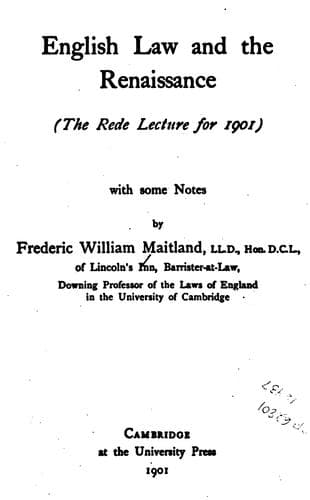
English Law and the Renaissance: The Rede Lecture for 1901Maitland, Frederic William
History
English Law and the Renaissance: The Rede Lecture for 1901
Maitland, Frederic William
Law -- England -- History; Renaissance -- England
[30] For Gentili see Holland, _Inaugural Lecture_, 1874, and _Dict. Nat.
Biog._ For his attack on canon law see _De nuptiis_, lib. I., c. 19. For
his quarrel with the ‘elegant’ Frenchmen, see _De iuris interpretibus
dialogi sex_. The defenders of the new learning and the _mos Gallicus_,
as it was called, threw at their adversaries the word ‘barbarian’; the
retort of the conservative upholders of the _mos Italicus_ was ‘mere
grammarian.’ By expelling such men as the Gentilis, Italy forfeited her
pre-eminence in the world of legal study. Nevertheless it is said that
both in France and Germany the practical Roman law of the courts was for
a long time the law of the ‘Bartolist’ tradition. Esmein (_Histoire du
droit français_, ed. 2, p. 776) says: ‘Cujas exerça sur le développement
des théories de droit romain suivies en France une action beaucoup moins
puissante que Du Moulin, et la filiation du romaniste Du Moulin n’est
pas niable: par la forme comme par le fond, c’est le dernier des grands
Bartolistes.’
[Sidenote: _Marsilianism and Henricianism._]
[31] Thomas Starkey, when he was trying to win over Reginald Pole to
Henry’s side, wrote thus: ‘Thes thyngs I thynke schal be somewhat in
your mynd confermyd by the redyng of Marsilius, whome I take, though he
were in style rude, yet to be of grete iugement, and wel to set out thys
mater, both by the authoryte of scripture and good reysonys groundyd in
phylosophy, and of thys I pray you send me your iugement.’ (_Starkey’s
England_, Early Engl. Text Soc. 1878, p. xxv.) Chapuis (the imperial
ambassador at Henry’s court) to Charles V, 3 Jan. 1534 (_Letters and
Papers of Henry VIII._, vol. VII., p. 6): ‘The little pamphlet composed
by the Council, which I lately sent to your Majesty, is only a preamble
and prologue of others more important which are now being printed. One
is called _Defensorium Pacis_, written in favour of the emperor Loys
of Bavaria against apostolic authority. Formerly no one dared read
it for fear of being burnt, but now it is translated into English so
that all the people may see and understand it.’ William Marshall to
Thomas Cromwell (_Ibid._, p. 178): ‘Whereas you promised to lend me £20
towards the printing of _Defensor Pacis_, which has been translated this
twelve-month, but kept from the press for lack of money, in trust of
your offer I have begun to print it. I have made an end of the Gift of
Constantine and of Erasmus upon the Creed.’ The ‘Gift of Constantine’
must be the famous treatise of Laurentius Valla. The translation of
Marsilius appeared on 27 July, 1535 (_Dict. Nat. Biog._ s.n. William
Marshall). In October twenty-four copies had been distributed among the
Carthusians in London (_Letters and Papers_, vol. IX., p. 171). In
1536 Marshall complained that the book had not sold, though it was the
best book in English against the usurped power of the bishop of Rome
(_Ibid._, vol. XI., p. 542). As to Byzantinism, if it be an accident it
Public-domain text, read in full here on John Shaqi.
Reviews
Reviews
No reviews yet
Be the first to share your thoughts on this work.
Join the Discussion
Join the discussion
Sign in to leave a comment or review.
Sign InorCreate an account