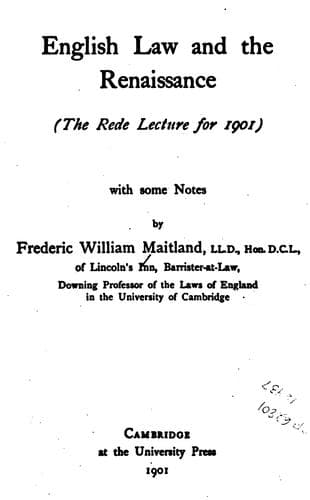
English Law and the Renaissance: The Rede Lecture for 1901Maitland, Frederic William
History
English Law and the Renaissance: The Rede Lecture for 1901
Maitland, Frederic William
Law -- England -- History; Renaissance -- England
is a memorable accident that the strongest statement of King Henry’s
divinely instituted headship of the church occurs in a statute which
enables unordained doctors of the civil (not canon) law to exercise that
plenitude of ecclesiastical jurisdiction which God has committed to the
king (_Stat._ 37 Hen. VIII., c. 17).
[Sidenote: _The Scotch Protestants and Justinian._]
[32] _Foreign Calendar_, 1558-9, p. 8. This seems to mean that the
normal and rightful relation of church to state is that which is to be
discovered in Justinian’s books. If so, ‘the Protestants of Scotland’
soon afterwards changed their opinions under the teaching of Geneva and
claimed for ‘the estate ecclesiastical’ a truly medieval independence.
[Sidenote: _The Henrician doctors of law. ‘The king’s great matter.’_]
[33] The following facts are taken from the _Dictionary of National
Biography_. Cuthbert Tunstall (afterwards bishop of Durham) ‘graduated
LL.D. at Padua.’ Stephen Gardiner (afterwards bishop of Winchester) of
Trinity Hall, Cambridge, ‘proceeded doctor of the civil law in 1520 and
of the canon law in the following year.… In 1524 he was appointed one
of Sir Robert Rede’s lecturers in the University.’ Edmund Bonner of
Broadgate Hall, Oxford, ‘in 1519 he took on two successive days (12 and
13 June) the degrees of bachelor of civil and of canon law.… On 12 July,
1525, he was admitted doctor of civil law.’ Thomas Thirlby (afterwards
bishop of Ely) of Trinity Hall, Cambridge, ‘graduated bachelor of the
civil law in 1521 … and proceeded doctor of the civil law in 1528 and
doctor of the canon law in 1530.’ Richard Sampson (afterwards bishop
of Lichfield) of Trinity Hall, Cambridge, ‘proceeded B.C.L. in 1505.
Then he went for six years to Paris and Sens and returning proceeded
D.C.L. in 1513.’ John Clerk (afterwards bishop of Bath and Wells, Master
of the Rolls), ‘B.A. of Cambridge 1499 and M.A. 1502, studied law and
received the doctor’s degree at Bologna.’ Richard Layton (afterwards
dean of York) ‘was educated at Cambridge, where he proceeded B.C.L. in
1522 and afterwards LL.D.’ Thomas Legh of King’s College (?), Cambridge,
‘proceeded B.C.L. in 1527 and D.C.L. in 1531.’ Instances of legal degrees
obtained in foreign universities are not very uncommon. John Taylor,
Master of the Rolls in 1527, ‘graduated doctor of law at some foreign
university, being incorporated at Cambridge in 1520 and at Oxford in
1522.’ James Denton, dean of Lichfield, proceeded B.A. in 1489 and M.A.
in 1492 at Cambridge. ‘He subsequently studied canon law at Valencia
in which faculty he became a doctor of the university there.’ (For an
earlier instance, that of Thomas Alcock of Bologna, see _Grace Book A_,
Luard Memorial, p. 209. There are other instances in Boase, _Register of
the University of Oxford_; consult index under Padua, Bologna, Paris,
Orleans, Bourges, Louvain.)
Public-domain text, read in full here on John Shaqi.
Reviews
Reviews
No reviews yet
Be the first to share your thoughts on this work.
Join the Discussion
Join the discussion
Sign in to leave a comment or review.
Sign InorCreate an account