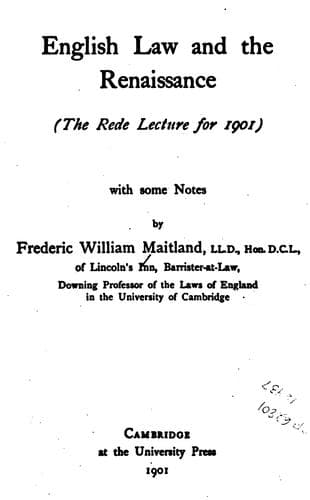
English Law and the Renaissance: The Rede Lecture for 1901Maitland, Frederic William
History
English Law and the Renaissance: The Rede Lecture for 1901
Maitland, Frederic William
Law -- England -- History; Renaissance -- England
That wonderful divorce cause, which shook the world, created a large
demand for the sort of knowledge that the university-bred jurist was
supposed to possess, especially as a great effort was made to obtain
from foreign doctors and universities opinions favourable to the king.
The famous Cambridge ‘Grecian’ Richard Croke was employed in ransacking
Italian libraries for the works of Greek theologians and in taking
council with Hebrew rabbis. In Italy, France and Spain, as well as in
England, almost every canonist of distinction, from the celebrated Philip
Decius downwards, must have made a little money out of that law suit, for
the emperor also wanted opinions.
[Sidenote: _Papists in the Inns of Court._]
[34] See the remarkable paper printed in _Calendar of Inner Temple
Records_, vol. I., p. 470; also Mr Inderwick’s preface pp. 1 ff. In 1570
Lincoln’s Inn had not been exacting the oath of supremacy: _Black Book_,
vol. I., pp. 369-372. See also the lives of Edmund Plowden, William
Rastell and Anthony Browne (the judge) in _Dict. Nat. Biog._: and for
Browne see also _Spanish Calendar_, 1558-67, pp. 369, 640.
[Sidenote: _Sir T. Smith’s ‘Commonwealth.’_]
[35] Smith, _Commonwealth of England_, ed. 1601, p. 147: ‘I haue declared
summarily as it were in a chart or map, or as Aristotle termeth it, ὡς ἐν
τύπῳ the forme and maner of gouernment of England, and the policy therof,
and set before your eyes the principall points wherin it doth differ from
the policy or gouernment at this time vsed in France, Italy, Spaine,
Germanie, and all other Countries, which doe follow the ciuill law of
the Romaines, compiled by Iustinian into his pandects and code: not in
that sort as Plato made his commonwealth, or Xenophon his kingdome of
Persia, nor as Sir Thomas More his Vtopia, beeing fained commonwealths,
such as neuer was nor neuer shall be, vaine imaginations, phantasies of
Philosophers to occupie the time, and to exercise their wits: but so as
England standeth, & is gouerned at this day the xxviij. of March. Anno
1565. in the vij. yeare of the raigne and administration thereof by the
most vertuous & noble Queene Elizabeth, daughter to King Henry the eight,
and in the one and fiftieth yeare of mine age, when I was Ambassadour for
her Maiestie, in the Court of Fraunce, the Scepter whereof at that time
the noble Prince and of great hope Charles Maximilian did holde, hauing
then raigned foure yeares.’
[Sidenote: _Smith writes without books._]
[36] Smith to Haddon, 6 Ap. 1565, in G. Haddoni _Orationes_, Lond. 1567,
pp. 302-7: ‘nostrarum legum ne unum quidem librum mecum attuli hic nec
habebam iure consultos quos consulerem.’ He has been telling how he wrote
_The Commonwealth of England_.
[Sidenote: _Roman law on the Continent._]
Public-domain text, read in full here on John Shaqi.
Reviews
Reviews
No reviews yet
Be the first to share your thoughts on this work.
Join the Discussion
Join the discussion
Sign in to leave a comment or review.
Sign InorCreate an account