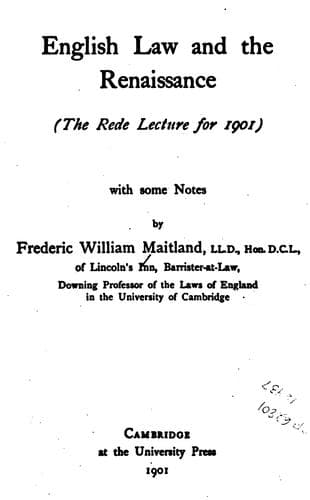
English Law and the Renaissance: The Rede Lecture for 1901 — John Shaqi
English Law and the Renaissance: The Rede Lecture for 1901Maitland, Frederic William
History
English Law and the Renaissance: The Rede Lecture for 1901
Maitland, Frederic William
Law -- England -- History; Renaissance -- England
[37] From the time of Bracton to the present day Englishmen have often
allowed themselves phrases which exaggerate the practical prevalence
of Roman law on the continent of Europe. Smith, for instance, who had
been in many parts of northern France and was a learned and observant
man, must have known that (to use Voltaire’s phrase) he often changed
law when he changed horses and that the Estates General had lately been
demanding a unification of the divergent customs (Viollet, _Histoire du
droit civil français_, p. 202; Planiol, _Droit civil_, 1900, vol. I., p.
16). Germans, who know what an attempt to administer Roman law really
means, habitually speak of French law as distinctively un-Roman. Thus
Rudolph Sohm (_Fränkisches Recht und römisches Recht_, Weimar, 1880, p.
76): ‘die Gesetzbücher Napoleons I. zeigen, dass noch heute wenigstens
das Privatrecht und Processrecht Frankreichs ein Abkömmling nicht des
römischen, noch des italienischen, sondern des fränkischen Rechtes ist.’
So Planiol (_op. cit._, vol. I., p. 26): ‘Deux courants se sont trouvés
en présence lors de l’unification du droit français: l’esprit romain et
les traditions coutumières. Ce sont ces dernières qui l’ont emporté.
Le Code a été rédigé à Paris, en plein pays coutumier; les conseillers
d’État appartenaient en majorité aux provinces septentrionales; le
parlement de Paris avait eu dans l’ancien droit un rôle prépondérant. Il
n’y a donc rien d’étonnant à voir l’esprit des coutumes prédominer dans
le Code; le contraire eût été un non-sens historique.’ Until the other
day it was, I believe, a common remark that the large part of Germany
which stood under the French code either in a translated or untranslated
form--and this part contained about one-sixth of the Empire’s
population--was the part of Germany in which the law was least Roman and
most Germanic. The division of France into two great districts was not
equal: before the acquisition of Elsass from Germany ‘les pays de droit
écrit comprenaient à peine les deux cinquièmes de la France’ (Planiol,
_op. cit._, vol. I., p. 11). See the useful map in Brissaud, _Histoire du
droit français_, p. 152. Even in the south there was much customary law.
A famous sentence in the custumal of Bordeaux placed ‘the written law’
below ‘natural reason’ (Viollet, _op. cit._, p. 150). Still it is not to
be denied that a slow process of romanization--very different from the
catastrophic Reception in Germany--went on steadily for some five or six
centuries; and a system which as a whole seems very un-Roman to a student
of what became ‘the common law’ of Germany may rightly seem Roman to an
Englishman. Francis Bacon knew that France could not be compendiously
described as a country governed by the civil law. In his speech on the
Union of Laws (Spedding, _Life and Letters_, vol. III., p. 337) he
accurately distinguishes ‘Gascoigne, Languedock, Provence, Dolphinie’
which are ‘governed by the letter or text of the civil law’ from ‘the
Public-domain text, read in full here on John Shaqi.
Reviews
Reviews
No reviews yet
Be the first to share your thoughts on this work.
Join the Discussion
Join the discussion
Sign in to leave a comment or review.
Sign InorCreate an account