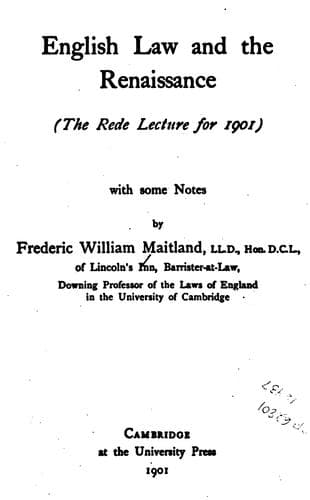
English Law and the Renaissance: The Rede Lecture for 1901 — John Shaqi
English Law and the Renaissance: The Rede Lecture for 1901Maitland, Frederic William
History
English Law and the Renaissance: The Rede Lecture for 1901
Maitland, Frederic William
Law -- England -- History; Renaissance -- England
Isle of France, Tourayne, Berry, Anjou and the rest, and most of all
Brittain and Normandy,’ which are ‘governed by customs which amount unto
a municipal law, and use the civil law but only for grounds and to decide
new and rare cases.’ English readers should at least know the doctrine,
strongly advocated in modern Germany, that the private law which was
developed in England by a French-speaking court was just one more French
_coutume_. Sohm, _Fränkisches Recht und römisches Recht_, p. 69: ‘Die
Vorgeschichte des englischen Rechts von heute hat nicht in England,
sondern in Nordfrankreich ihre Heimath … Stolz kann die Lex Salica auf
die zahlreichen und mächtigen Rechte blicken, welche sie erzeugt hat.’
[38] Blackstone, _Commentaries_, vol. III., p. 149; J. H[oddesdon], _Tho.
Mori Vita_, Lond. 1652, p. 26.
[39] Smith, _Commonwealth_, ed. 1601, p. 141: ‘_withernam_ … is in plaine
Dutch and in our olde Saxon language _wyther nempt_.’
[Sidenote: _Barbarous language of the law._]
[40] Pollock, _First Book of Jurisprudence_, p. 283, from Dyer’s
_Reports_, 188 _b_, in the notes added in ed. 1688: ‘Richardson, ch.
Just. de C. Banc. al Assises at Salisbury in Summer 1631. fuit assault
per prisoner la condemne pur felony que puis son condemnation ject un
Brickbat a le dit Justice que narrowly mist, & pur ceo immediately fuit
indictment drawn per Noy envers le prisoner, & son dexter manus ampute
& fix al Gibbet sur que luy mesme immediatment hange in presence de
Court.’ In France the Ordonnance of Villers-Cotterets (1539) decreed
that the judgments of the French courts should be recorded no longer
in Latin but in French. ‘L’utilité de cette innovation … se comprend
assez d’elle-même. On dit qu’un motif d’une autre nature, l’intérêt des
belles-lettres, ne contribua pas moins à y décider le roi [François
I], choqué du latin barbare qu’employaient les tribunaux. Un arrêt
rendu en ces termes: _Dicta curia debotavit et debotat dictum Colinum
de sua demanda_, fut, dit on, ce qui entraîna la suppression du latin
judiciaire.’ Henri Martin, _Histoire de France_, vol. VIII., pp. 272-3;
see also Christie, _Étienne Dolet_, ed. 2, p. 424.
[Sidenote: _The fate of Duns Scotus._]
[41] Ellis, _Original Letters_, Ser. II., vol. II., p. 61, Dr Layton to
Cromwell: ‘We have sett Dunce in Bocardo and have utterly banished him
Oxforde for ever, with all his blynd glosses, and is now made a common
servant to evere man, fast nailede up upon posts in all common howses of
easement.’
[Sidenote: _The English Lex Regia._]
[42] _Stat._ 31 Hen. VIII., cap. 8. Already in 1535 Cromwell reports with
joy an opinion obtained from the judges to the effect that in a certain
event the king might issue a proclamation which would be ‘as effective as
any statute’ (_Letters and Papers, Henry VIII._, vol. VIII., p. 411).
[Sidenote: _Civilians in councils and in courts. Project for a new
court._]
Public-domain text, read in full here on John Shaqi.
Reviews
Reviews
No reviews yet
Be the first to share your thoughts on this work.
Join the Discussion
Join the discussion
Sign in to leave a comment or review.
Sign InorCreate an account