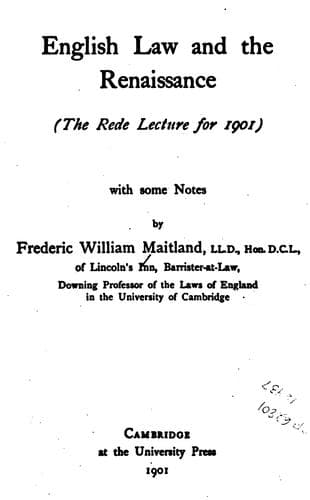
English Law and the Renaissance: The Rede Lecture for 1901Maitland, Frederic William
History
English Law and the Renaissance: The Rede Lecture for 1901
Maitland, Frederic William
Law -- England -- History; Renaissance -- England
[54] As to the evil done to the peasants in Germany by the Reception
of Roman law, see Egelhaaf, _Deutsche Geschichte_ (_Zeitalter
der Reformation_), vol. I., pp. 544 ff.; Lamprecht, _Deutsche
Geschichte_, vol. V., pp. 99 ff. Dr Brunner (_Grundzüge der deutschen
Rechtsgeschichte_, 1901, p. 216) has lately said that Roman jurisprudence
‘auch wenn sie nicht geradezu bauernfeindlich war, doch kein Verständnis
besass für die Mannigfaltigkeit der bäuerlichen Besitzformen des
deutschen Rechtes.’ One of the revolutionary programmes proposed an
exclusion of all doctors of civil or canon law from the courts and
councils of the princes. See Egelhaaf, _op. cit._, pp. 499, 598. The
following is a pretty little tale:--‘So geschah es wirklich einmal zu
Frauenfeld im Thurgau, wo die Schöffen einen Doctor aus Constanz, der
sich für die Entscheidung eines Erbschaftsstreites auf Bartolus und
Baldus berufen wollte, zur Thüre hinauswarfen mit den Worten: “Hört ihr,
Doctor, wir Eidgenossen fragen nicht nach dem Bartele und Baldele. Wir
haben sonderbare Landbräuche und Rechte. Naus mit euch, Doctor, naus mit
euch!” Und habe, heisst es in dem Berichte weiter, der gute Doctor müssen
abtreten, und sie Amtleute haben sich einer Urtel verglichen, den Doctor
wieder eingefordert und ein Urtel geben wider den Bartele und Baldele
und wider den Doctor von Constanz.’ (Janssen, _Geschichte des deutschen
Volkes_, vol. I., p. 490.) It is a serious question what would have
become of our English copyholders if in the sixteenth century Roman law
had been received. The practical jurisprudence of this age seems to have
been kinder to the French than to the German peasant; perhaps because it
was less Roman in France than in Germany. See E. Levasseur in Lavisse
et Rambaud, _Histoire générale_, vol. IV., p. 188: ‘Des jurisconsultes
commencèrent à considérer l’inféodation comme une aliénation et le colon
censitaire comme le véritable propriétaire de la terre sur laquelle le
seigneur n’aurait possédé qu’un droit _éminent_.’ The true Romanist, I
take it, can know but one _dominium_, and is likely to give that one to
the lord.
[Sidenote: _England and Germany. The Reception in Scotland._]
Public-domain text, read in full here on John Shaqi.
Reviews
Reviews
No reviews yet
Be the first to share your thoughts on this work.
Join the Discussion
Join the discussion
Sign in to leave a comment or review.
Sign InorCreate an account