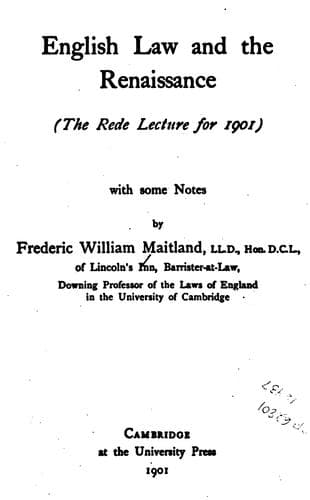
English Law and the Renaissance: The Rede Lecture for 1901Maitland, Frederic William
History
English Law and the Renaissance: The Rede Lecture for 1901
Maitland, Frederic William
Law -- England -- History; Renaissance -- England
[55] As regards Germany, the theoretical continuance of the Roman empire
is not to be forgotten, but its influence on the practical Reception of
Roman law may be overrated. In the age of the Reception Roman law came to
the aid, not of imperialism, but of particularism. Then it is true that
English law was inoculated in the thirteenth century when Bracton copied
from Azo of Bologna. The effect of this is well stated by Dr Brunner
in the inaugural address delivered by him as rector of the University
of Berlin (_Der Antheil des deutschen Rechtes an der Entwicklung der
Universitäten_, Berlin, 1896, p. 15): ‘In England und Frankreich, wo
die Aufnahme römischer Rechtsgedanken früher erfolgte, hat diese nach
Art einer prophylactischen Impfung gewirkt und das mit ihnen gesättigte
nationale Recht widerstandsfähig gemacht gegen zerstörende Infectionen.’
As to the Roman law in Bracton, I may be allowed to refer to _Bracton
and Azo_, Selden Society, 1895: in the introduction to that volume I
have ventured to controvert some sentences that were written by Sir
H. Maine. Bracton became important for a second time in the sixteenth
century when (1569) his book was printed, for it helped Coke to arrange
his ideas, as any one may see who looks at the margin of Coke’s books.
The medieval chancery has often been accused of romanizing. Its procedure
was suggested by a summary procedure that had been devised by decretists
and legists: the general aim of that scheme was the utmost simplicity and
rapidity. (Contrast this summary procedure as revealed by _Select Cases
in Chancery_, ed. Baildon, and _Select Cases in the Court of Requests_,
ed. Leadam, with the solemn procedure of the civil law exemplified by
_Select Cases in the Court of Admiralty_, ed. Marsden: these three
books are published by the Selden Society.) On the other hand, no proof
has been given that in the middle age the chancery introduced any
substantive law of Roman origin. At a later time when it began to steal
work (suits for legacies and the like) from the ecclesiastical courts, it
naturally borrowed the rules by which those matters had theretofore been
governed.
Public-domain text, read in full here on John Shaqi.
Reviews
Reviews
No reviews yet
Be the first to share your thoughts on this work.
Join the Discussion
Join the discussion
Sign in to leave a comment or review.
Sign InorCreate an account