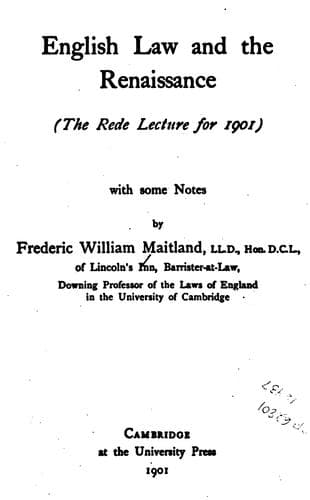
English Law and the Renaissance: The Rede Lecture for 1901 — John Shaqi
English Law and the Renaissance: The Rede Lecture for 1901Maitland, Frederic William
History
English Law and the Renaissance: The Rede Lecture for 1901
Maitland, Frederic William
Law -- England -- History; Renaissance -- England
Turning to a more serious aspect of affairs, it would not I think be
difficult to show that the pathway for a Reception was prepared. Not
difficult but perhaps wearisome. At this point it is impossible for us to
forget that the year 1485, if important to students of English history
for other reasons, is lamentably important for this reason, that there
Dr Stubbs laid down his pen. In his power of marshalling legal details
so as to bring to view some living principle or some phase of national
development he has had no rival and no second among Englishmen. Howbeit,
we may think of the subjected church and the humbled baronage, of the
parliament which exists to register the royal edicts, of the English _Lex
Regia_ which gives the force of statute to the king’s proclamations[42],
of the undeniable faults of the common law, of its dilatory methods,
of bribed and perjured juries, of the new courts which grow out of the
King’s Council and adopt a summary procedure devised by legists and
decretists. Might not the Council and the Star Chamber and the Court
of Requests--courts not tied and bound by ancient formalism,--do the
romanizing work that was done in Germany by the Imperial Chamber Court,
the _Reichskammergericht_[43]? This was the time when King Henry’s nephew
James V was establishing a new court in Scotland, a College of Justice,
and Scotland was to be the scene of a Reception[44].
It seems fairly certain that, besides all that he effected, Henry had at
times large projects in his mind: a project for a great college of law
(possibly a College of Justice in the Scotch sense), a project for the
reformation of the Inns of Court, which happily were not rich enough to
deserve dissolution[45], also perhaps a project for a civil code as well
as the better known project for a code ecclesiastical. In Edward VI’s
day our Regius and German Professor of Divinity, Dr Martin Butzer, had
heard, so it seems, that such a scheme had been taken in hand, and he
moved in circles that were well informed. He urged the young Josiah to go
forward in the good work; he denounced the barbarism of English law and
(to use Bentham’s word) its incognoscibility[46]. The new ecclesiastical
code, as is generally known, was never enacted; but we know equally well
that the draft is in print. Its admired Latinity is ascribed to Prof.
Smith’s immediate successor, Dr Walter Haddon. I take it that now-a-days
few English clergymen wish that they were living--or should I not say
dying?--under Dr Haddon’s pretty phrases[47]. Codification was in the
air. Both in France and in Germany the cry for a new Justinian was being
raised, and perhaps we may say that only because a new Justinian was not
forthcoming, men endeavoured to make the best that they could of the
old[48]. How bad that best would be Francis Hotman foretold.
Public-domain text, read in full here on John Shaqi.
Reviews
Reviews
No reviews yet
Be the first to share your thoughts on this work.
Join the Discussion
Join the discussion
Sign in to leave a comment or review.
Sign InorCreate an account